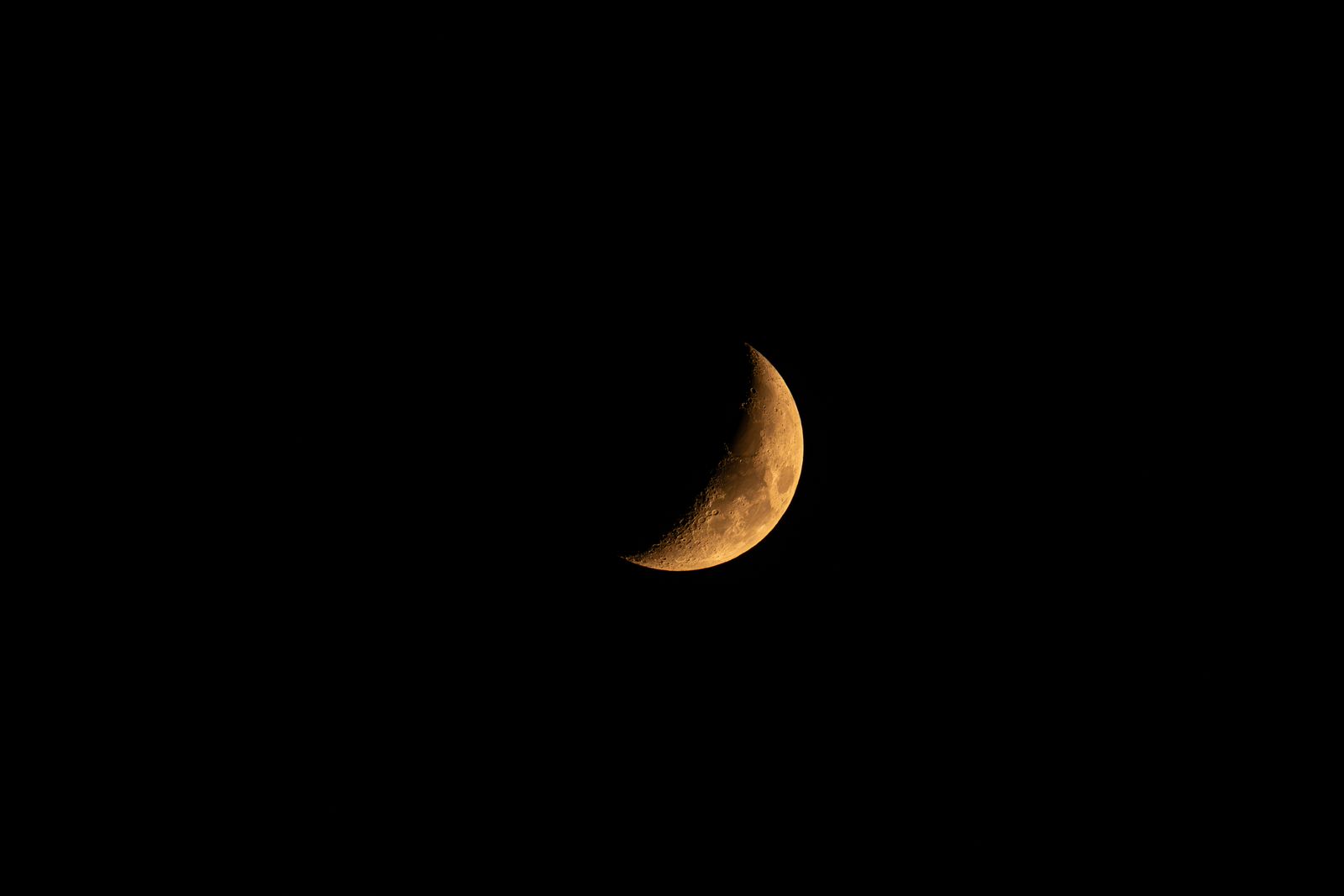
The Moon is continually releasing sodium atoms into space, creating a faint comet-like tail that can extend for roughly half a million miles, or about 800,000 kilometres. Boston University astronomers identified the distant tail in observations made in 1998, revealing a structure far larger than the Moon itself but far too faint for the unaided human eye.
The tail is present throughout the lunar orbit, although its shape and brightness constantly change. Around new moon, the Moon passes between Earth and the Sun, the sodium stream points towards our planet, and Earth’s gravity concentrates part of it into a diffuse yellow-orange spot in the night sky beyond Earth.
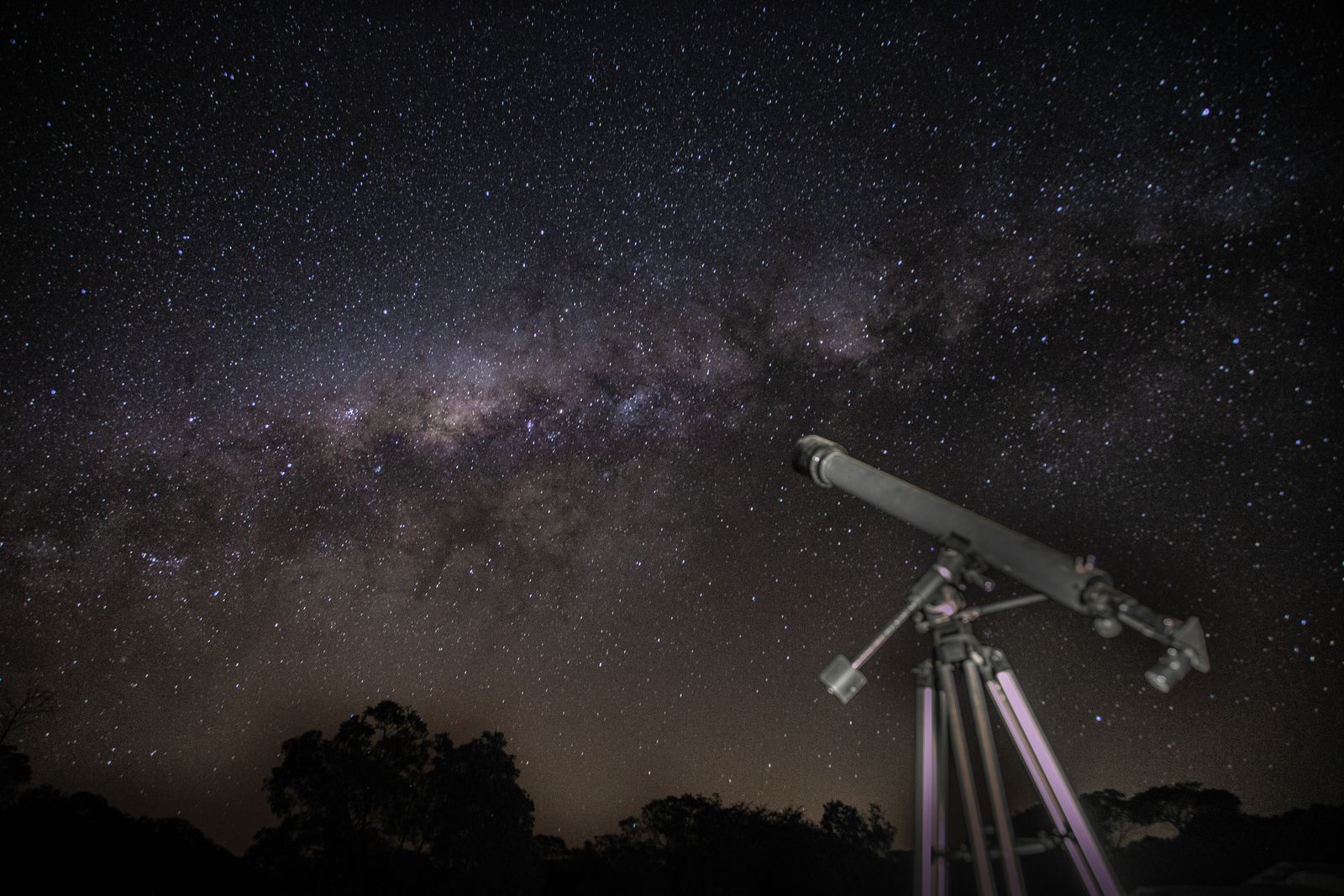
What you would see, if your eyes could see it
Sodium produces an exceptionally recognisable colour. Its strongest visible emissions are the closely spaced D-lines near 589 nanometres, the same yellow-orange wavelengths associated with traditional low-pressure sodium streetlamps and sodium released by meteors in Earth’s upper atmosphere.
The lunar tail scatters sunlight at those wavelengths. Near new moon, its brightest portion can appear as a diffuse patch roughly three degrees across, several times the apparent width of the full Moon. It is not a sharply defined beam or a miniature comet tail hanging from the lunar surface. It is a broad, faint cloud whose individual atoms are spread across an enormous volume of space.
Boston University researchers estimated that the feature would need to be roughly a thousand times brighter for human eyes to see it directly. A wide-field telescope fitted with a narrow-band sodium filter can isolate the correct wavelengths and record the glow through long exposures.
How to photograph a spot in apparently empty sky
The distant tail was discovered during observations at McDonald Observatory in Texas. The Boston University team included Jeffrey Baumgardner and was led by Michael Mendillo, with Steven Smith and Jody Wilson among the researchers involved in the early detection and modelling work.
The telescope does not simply point at the visible Moon. Around new moon, observers examine the anti-solar region of the sky, where the stream of lunar sodium extends beyond Earth. They collect wide-field exposures through a sodium filter and then account for stars, airglow, and the sodium naturally present in Earth’s own mesosphere.
Once those competing sources are separated, a broad sodium enhancement emerges. Later observing programmes detected the feature routinely around new moon, confirming that the 1998 event was not a one-off cloud produced solely by the Leonid meteor storm.
The processes that release sodium
The Moon has no dense atmosphere, but it is surrounded by an exosphere. This is an extraordinarily sparse population of atoms and molecules whose particles travel along long ballistic paths instead of repeatedly colliding as they would in Earth’s atmosphere.
Studies of the lunar sodium tail identify three important release processes: photon-stimulated desorption, solar-wind sputtering, and vaporisation caused by meteoroid impacts. Ultraviolet photons can dislodge sodium from exposed grains, charged particles in the solar wind can knock atoms from the surface, and high-speed impacts can briefly heat and vaporise small quantities of regolith.
The relative importance of those processes depends on the element, the surface conditions, and the timescale being considered. A 2024 analysis of Apollo soil isotopes found that impact vaporisation has been the dominant long-term source sustaining the Moon’s broader exosphere, while solar-wind sputtering also makes a substantial contribution.
The surface itself complicates the calculation. A 2025 study using an Apollo 16 sample and three-dimensional simulations found that the roughness and high porosity of real lunar regolith can strongly suppress solar-wind sputtering. Models built around flat, idealised surfaces may therefore overestimate how efficiently ions eject material from the Moon.
Why the tail brightens around new moon
Once sodium atoms rise high enough above the lunar surface, sunlight begins pushing them away from the Sun. The force on each atom is tiny, but it acts continuously, accelerating the sodium into an anti-solar stream.
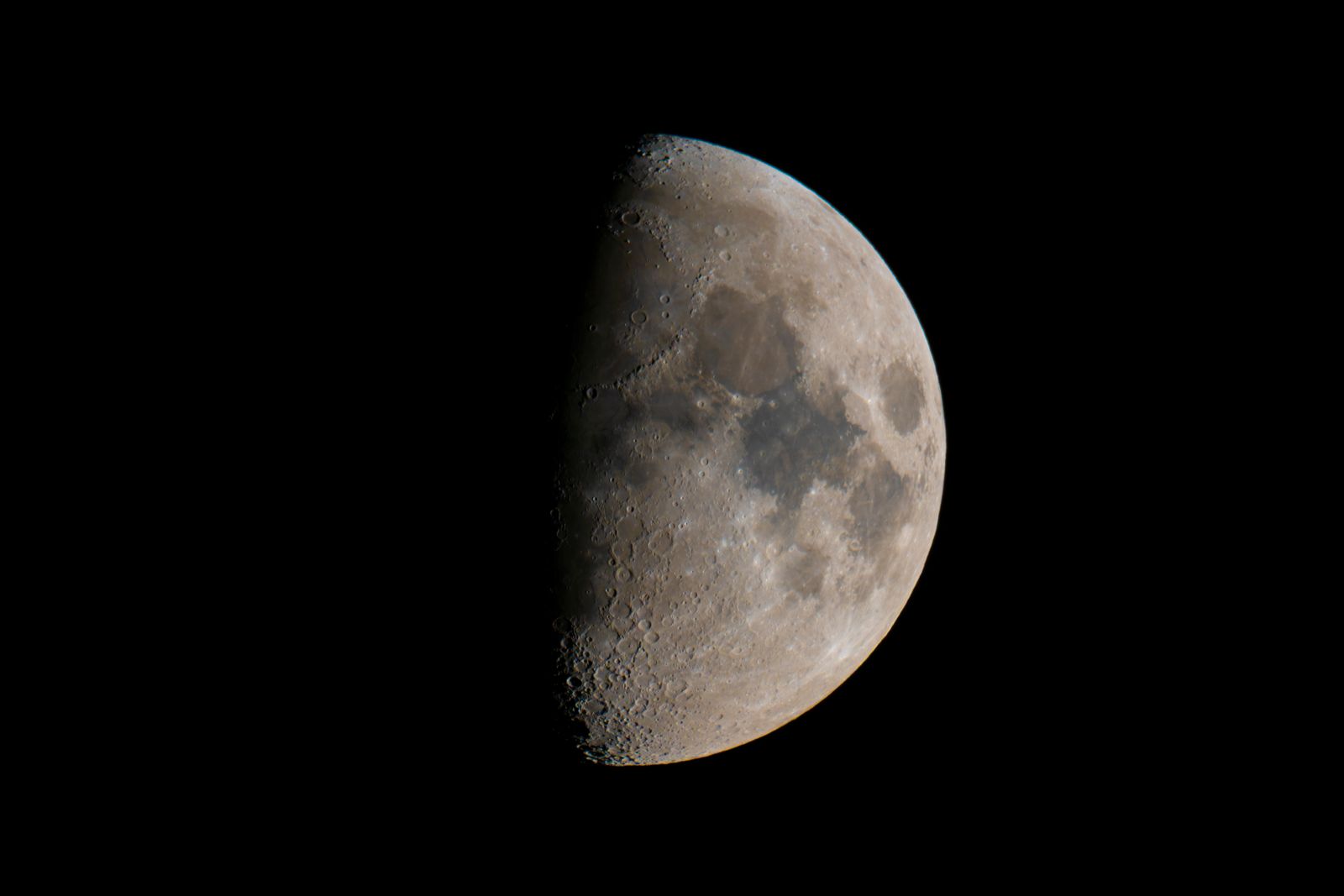
Most of the month, that stream points elsewhere in space. Near new moon, the Moon lies approximately between the Sun and Earth, placing our planet in the path of the extended sodium cloud. Earth’s gravity deflects the slower atoms and focuses part of the stream into a denser region beyond the planet.
That focused region is often called the sodium moon spot. It generally appears for a limited period around new moon and changes in position, shape, and brightness as the observing geometry shifts.
Meteoroid activity can make it brighter. The 1998 discovery followed the Leonid meteor storm, when increased impacts on the lunar surface released additional sodium. Earlier observations from August 1998 later revealed a much fainter version of the same extended feature, demonstrating that the tail also exists outside an exceptional meteor event.
Sodium tails elsewhere in the Solar System
The Moon is not the only nearby body with an extended sodium cloud. Mercury possesses an even more dramatic example. Boston University’s wide-field observations showed that Mercury’s sodium tail reaches approximately 2.5 million kilometres, more than 100 times the planet’s radius.
Io, Jupiter’s intensely volcanic moon, supplies sodium to a vast neutral cloud around Jupiter. Comets can also develop sodium tails when solar heating releases material from their surfaces. These examples are produced under different conditions, but all show how sodium’s strong interaction with sunlight makes small quantities of escaping material visible across immense distances.
Sodium is only one constituent of the lunar environment. Observations have also identified elements and gases including potassium, helium, argon, and neon. Their abundances respond differently to sunlight, surface temperature, solar-wind conditions, and radioactive decay within the lunar crust.
China’s Chang’E-6 mission added another piece to that inventory. Instruments on the lunar far side detected a layer of negative ions close to the surface. The ions appear to be created when solar-wind particles interact with regolith, but their short lifetimes mean the finding should not be interpreted as evidence of another Moon-spanning tail.
How much material is actually escaping
The sodium tail proves that the lunar surface is dynamic, but it does not mean the Moon is rapidly eroding or shrinking. The number of escaping atoms is minuscule compared with the Moon’s total mass, and release rates can change substantially with meteor activity, solar conditions, and local surface composition.
Many atoms knocked from the regolith do not escape permanently. Some travel along ballistic arcs and fall back onto another part of the surface. Others become ionised, are redirected by electromagnetic fields, or acquire enough energy to join the extended tail.
The exchange between Earth and the Moon is not entirely one-way. Modelling published in 2025 found that ions from Earth’s atmosphere can be transferred efficiently to the lunar surface when the Moon passes through Earth’s magnetotail. Traces of Earth’s atmospheric history may therefore be preserved in lunar regolith alongside material produced or implanted by the solar wind.
Mapping which parts of the Moon supply the exosphere
Observing the tail reveals that atoms are leaving the Moon, but determining exactly which terrains supply them requires more detailed maps of lunar chemistry. Surface composition varies across maria, highlands, impact basins, and permanently shadowed regions, and those differences may influence what enters the exosphere.
A team led by Airi Toida and Yuichiro Ezoe at Tokyo Metropolitan University has proposed a compact way to improve those maps. Their lunar X-ray telescope concept would use solar flares as a natural illumination source. Incoming solar X-rays would strike the Moon, causing surface elements to fluoresce at characteristic energies that an orbiting detector could measure.
The proposed telescope would weigh less than ten kilograms. Simulations suggest one instrument could map oxygen, iron, magnesium, aluminium, and silicon across the Moon in approximately two years. A five-by-five array of detectors could produce finer maps, add sodium measurements, and reach grid scales of roughly 30 by 30 kilometres.
Such observations would not identify the source of every atom individually, but they would give researchers a far stronger basis for comparing changes in the exosphere with the chemistry and physical structure of the terrain below.
Watching the Moon’s exosphere change
The lunar exosphere is continually responding to its environment. Meteor showers can inject fresh material. Changes in the solar wind alter sputtering and ionisation. Sunrise heats the regolith and changes the release of volatile atoms, while night brings extreme cooling and different patterns of adsorption.
The sodium spot records part of that activity remotely. By tracking its brightness and shape over many lunar cycles, astronomers can investigate whether a change came from a meteoroid stream, unusual solar conditions, or the Moon’s changing position relative to Earth and the Sun.
Because the tail can be monitored from the ground with specialised wide-field instruments, it offers a rare way to study the loss and redistribution of material from an airless world without placing a spacecraft beside every escaping atom.
The astronomer’s paradox
Sodium around the Moon had been observed before 1998, but the enormous distant tail remained hidden. Its discovery required the correct observing geometry, a filter tuned to sodium’s narrow emission lines, a wide enough field of view, and careful separation of the signal from Earth’s own sodium glow.
The feature is therefore both immense and elusive. It stretches hundreds of thousands of kilometres through space, yet its light arrives as a diffuse enhancement in a patch of sky that otherwise appears empty.
At every new moon, the geometry brings that stream back towards Earth. A telescope records the faint amber spot, solar pressure carries fresh atoms downstream, and the Moon continues releasing and recycling material into the space around it. The tail is not a static structure hanging behind the Moon. It is the visible trace of an airless world that is still interacting with everything around it.