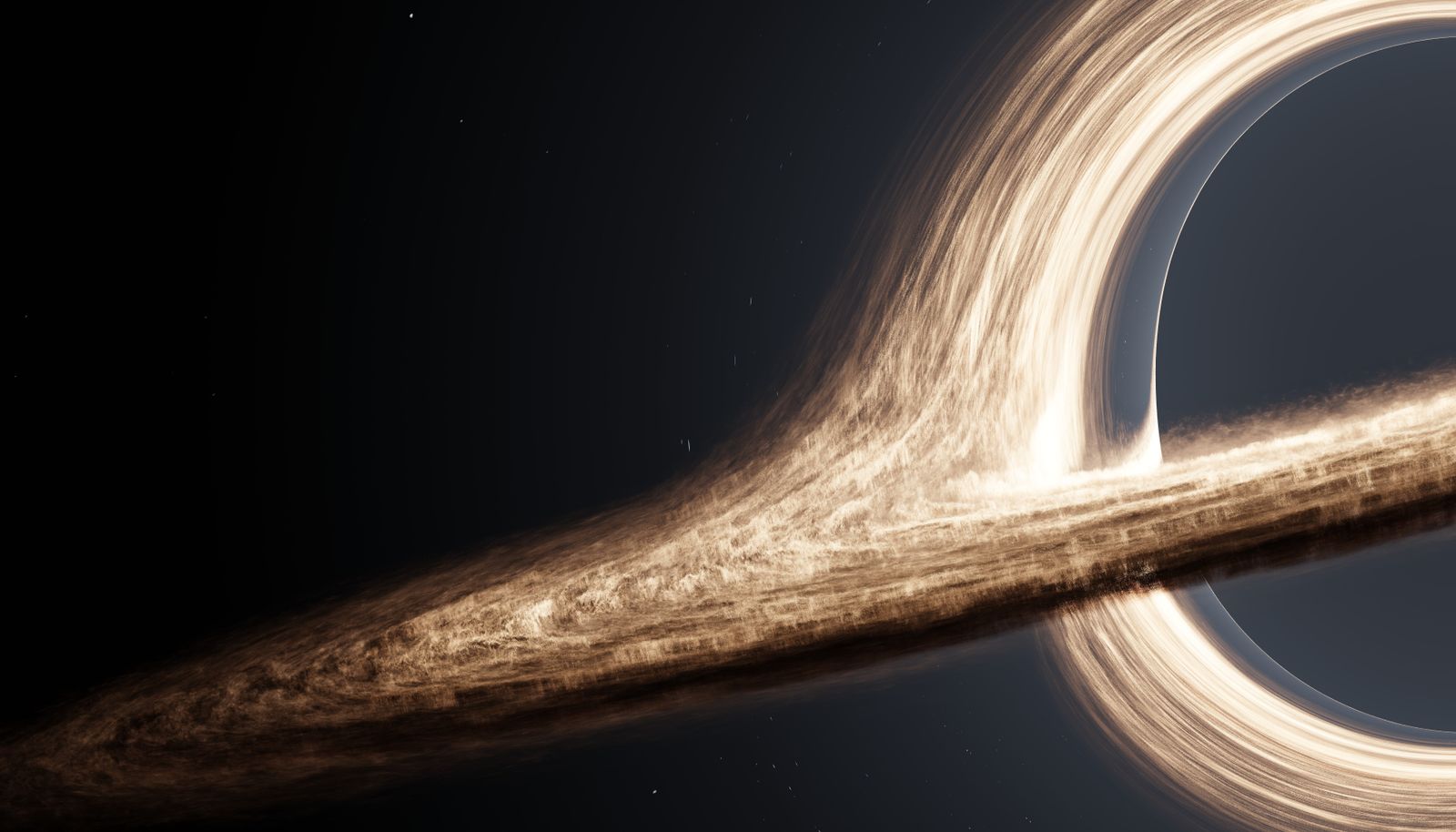
On January 14, 2025, a gravitational-wave signal rolled through the twin LIGO detectors in Hanford, Washington, and Livingston, Louisiana. Designated GW250114, it came from two black holes of roughly 32 and 34 solar masses merging more than a billion light-years away, and it resembled the event that gave LIGO its historic first detection in 2015.
There was one crucial difference: GW250114 was dramatically clearer. When the result was published in September 2025, close to the tenth anniversary of LIGO’s first detection, Nature described it as the clearest gravitational-wave detection yet confirming Hawking’s black-hole theory.
The result gave physicists their strongest observational test so far of Stephen Hawking’s black-hole area theorem. The theorem says that, under the classical conditions of general relativity, the total area of black-hole event horizons cannot decrease. In GW250114, the estimated combined horizon area grew from about 240,000 square kilometres before the merger to about 400,000 square kilometres afterward, a result also detailed in coverage of LIGO’s tenth anniversary and the new test.
The theorem Hawking wrote before black holes were directly observed
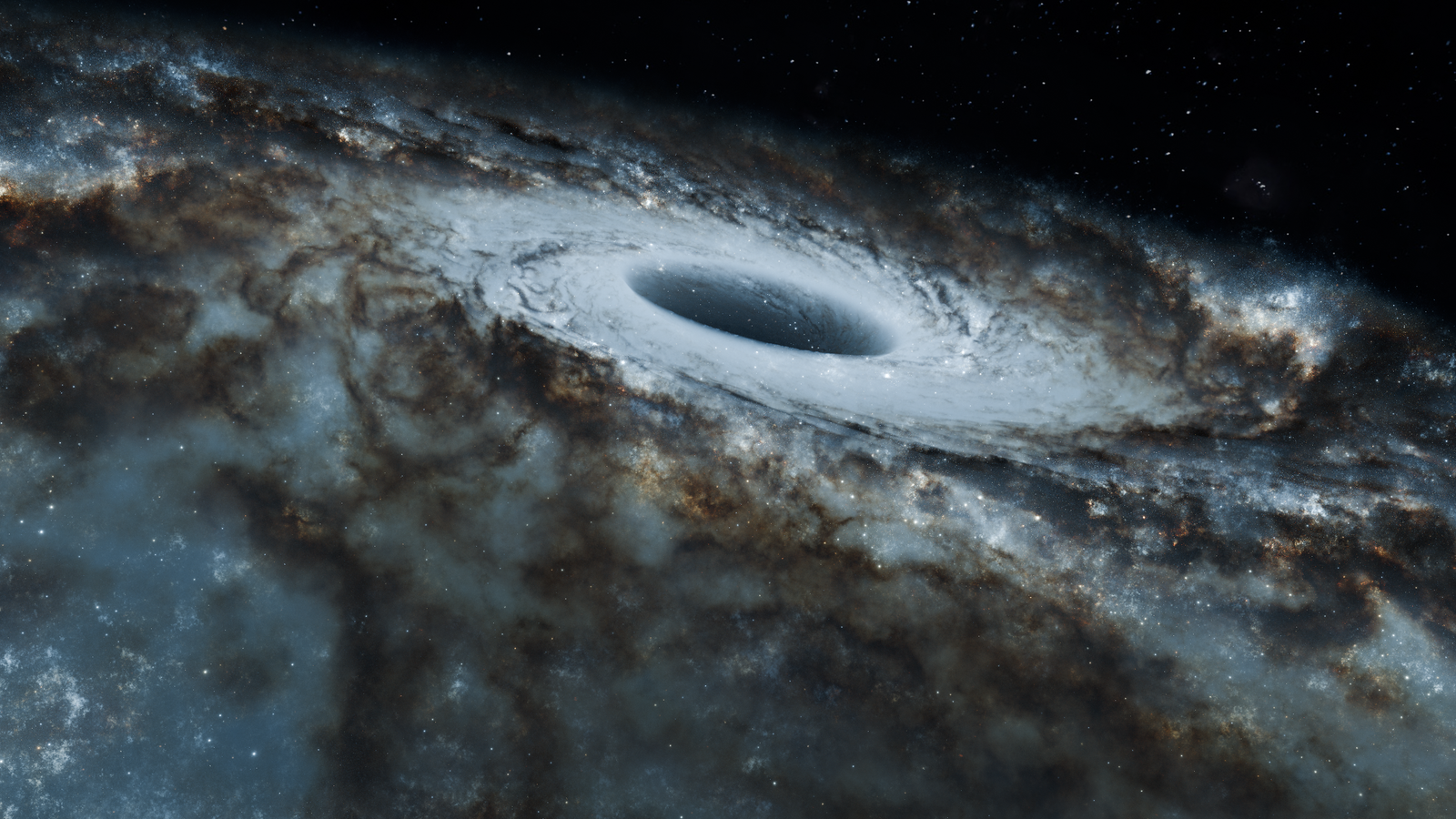
Hawking formulated his area theorem in 1971, when black holes were still objects physicists understood mainly through theory and indirect astronomical evidence. The event horizon, the boundary beyond which light cannot escape, behaved in his equations almost like a one-way quantity: in classical general relativity, its area could increase but could not decrease.
The idea became part of a deeper thermodynamic picture. James Bardeen, Brandon Carter and Hawking developed the laws of black-hole mechanics, while Jacob Bekenstein argued that a black hole should carry entropy proportional to the area of its horizon. Hawking’s later discovery of black-hole radiation supplied the quantum ingredient that connected temperature, entropy and gravity even more tightly.
But GW250114 was not the first observational check of the area theorem. Researchers used the original 2015 event, GW150914, for an initial test reported in 2021, finding consistency with the theorem at about 95 percent confidence. GW250114 provided the second test with far greater precision, pushing the reported confidence to roughly 99.999 percent.
How you measure a horizon you cannot see
The trick lies in the gravitational wave itself. During the inspiral, the waveform encodes information about the masses and spins of the two incoming black holes. After they merge, the remnant settles through a phase called ringdown, whose frequencies and decay rates reveal properties of the newly formed object.
For a rotating Kerr black hole, mass and spin determine the area of its event horizon. That allows physicists to infer the combined horizon area before a merger and compare it with the area of the remnant afterward without ever seeing the horizons directly.
GW250114 was clear enough for researchers to resolve two distinct ringdown modes. Penn State physicist B.S. Sathyaprakash emphasized the importance of that spectrum, and Penn State’s account of the result described the signal as providing the distinctive gravitational-wave signature expected from a black hole. The observations were consistent with the remnant being the spinning Kerr black hole predicted by general relativity.
A detector that reads changes smaller than a proton
Extracting that information requires instruments of extraordinary sensitivity. Each LIGO observatory uses two four-kilometre vacuum arms arranged at right angles. Laser light travels between suspended mirrors, and interference between the beams reveals minute changes in the lengths of the arms as a gravitational wave passes.
The distortions LIGO measures can be smaller than one-ten-thousandth the width of a proton, or around 700 trillion times smaller than the width of a human hair. Reaching that scale has required years of work on mirror coatings, seismic isolation, laser power and quantum techniques that reduce measurement noise.
The improvement has transformed gravitational-wave astronomy from rare detection into population science. In May 2026, the collaboration’s GWTC-5.0 release reported that the total number of confirmed gravitational-wave events observed by the network had reached 390, following 161 newly catalogued events from the second part of the fourth observing run.
The first chirp, ten years on
The signal that began the gravitational-wave era reached Earth on September 14, 2015. Two black holes, about 36 and 29 times the mass of the Sun, had merged roughly 1.3 billion light-years away, producing the brief rising-frequency signal that became known as LIGO’s first chirp. LIGO’s tenth-anniversary account describes that event as the first direct detection of gravitational waves.
Rainer Weiss, Barry Barish and Kip Thorne shared the 2017 Nobel Prize in Physics for decisive contributions to LIGO and the observation. What had begun as a single extraordinary event quickly became a new way of studying objects that emit little or no light.
A decade later, the question is no longer simply whether binary black holes exist or whether gravitational waves can be detected. Researchers can now ask how black holes form, how their masses and spins are distributed, whether the remnants obey general relativity and whether the details of a merger expose physics that was previously inaccessible.
The heaviest collision yet found by the network
Some of the newer events have been far more massive than the first 2015 merger. In July 2025, the collaboration announced GW231123, an event involving black holes estimated at roughly 100 and 140 solar masses. Their collision produced a remnant of approximately 225 solar masses, making it the most massive black-hole merger LIGO, Virgo and KAGRA had reported at the time.
The component masses come with substantial uncertainties, so the event cannot be reduced to a simple claim that one object sat neatly inside a particular forbidden mass interval. What is clear is that the unusually large masses and rapid spins are difficult to explain through ordinary single-star evolution alone.
One possibility is hierarchical growth: a black hole produced in an earlier merger later joins another binary and merges again. Events such as GW231123 therefore turn gravitational-wave catalogues into a record not only of individual collisions but of how black-hole populations may assemble across cosmic time.
What the ringdown reveals
The ringdown of GW250114 did more than provide the quantities needed for the area-theorem test. Its resolved modes also agreed closely with the frequencies predicted for a Kerr black hole, the mathematical solution in general relativity that describes a rotating, electrically neutral black hole.
That makes the event a particularly strong test of the black-hole interpretation. It does not prove that every conceivable exotic compact object has been eliminated in every circumstance, but it sharply constrains alternatives for this signal and strengthens the case that the remnant behaves as general relativity says a black hole should.
This is increasingly what gravitational-wave astronomy looks like: precision tests instead of simple detections, population studies instead of isolated curiosities, and rapid alerts that allow conventional observatories to look for electromagnetic counterparts when a source is expected to produce light.
The 2025 budget threat was real, but the status has moved on
The tenth-anniversary celebrations took place amid a serious funding fight. In 2025, the Trump administration proposed cutting the National Science Foundation’s overall budget by more than half. The proposal included an approximately $19 million reduction to LIGO operations, around 40 percent below 2024 levels, and raised the possibility of shutting down one of the two U.S. detectors. Scientific American documented the proposed cuts and their scientific consequences.
The loss of one detector would dramatically reduce the network’s reach and its ability to distinguish real signals from local noise. The same analysis estimated that operating a single LIGO detector would cut the searchable volume to about 35 percent of the two-detector value and reduce the expected detection rate still further once confirmation requirements were included.
That 2025 proposal should not, however, be presented as the present operating status. By July 2026, the official observing plan stated that both LIGO detectors were expected to observe during the upcoming Intermediate Run 1, planned to begin between late October and mid-November 2026. Planning for the fifth full observing run remains under discussion as detector upgrades continue.
What comes after LIGO
The next generation of gravitational-wave observatories aims to push much farther into the universe. Proposed ground-based projects such as Cosmic Explorer in the United States and the Einstein Telescope in Europe are designed to extend both sensitivity and frequency coverage, potentially exposing black-hole mergers from much earlier eras of cosmic history.
Space will open another part of the gravitational-wave spectrum. The Laser Interferometer Space Antenna, or LISA, will use three spacecraft flying millions of kilometres apart to detect lower-frequency waves, including signals from merging supermassive black holes. As of 2026, LISA remains an ESA-led mission with NASA as a major partner, and NASA says it is contributing both hardware and software. Launch is currently planned for 2035.
The important shift is already visible in the data on the ground. LIGO began by proving that gravitational waves could be detected at all. It now measures black-hole populations, tests the structure of merger remnants and turns equations written decades ago into quantities that can be checked against real signals.
What Hawking would have seen
Stephen Hawking died in March 2018, after LIGO’s first detections but before either observational test of his area theorem was published. He lived to see gravitational waves become an astronomical tool and to see binary black holes move from theoretical possibility to observed population, but not to see the cleanest measurement of the theorem he formulated as a young physicist.
GW250114 supplied that measurement. Two black holes entered the merger with one combined horizon area; the remnant emerged with a larger one even after several solar masses’ worth of energy had been radiated into spacetime as gravitational waves. Under the classical conditions Hawking’s theorem describes, the area behaved exactly as the equations required.
The signal travelled for more than a billion years before crossing two L-shaped detectors in Louisiana and Washington on January 14, 2025. The result was published eight months later, almost exactly a decade after LIGO first heard the universe chirp. Fifty-four years after Hawking wrote down the theorem, the mathematics had not merely survived another calculation. It had survived one of the clearest black-hole collisions nature has yet allowed us to hear.