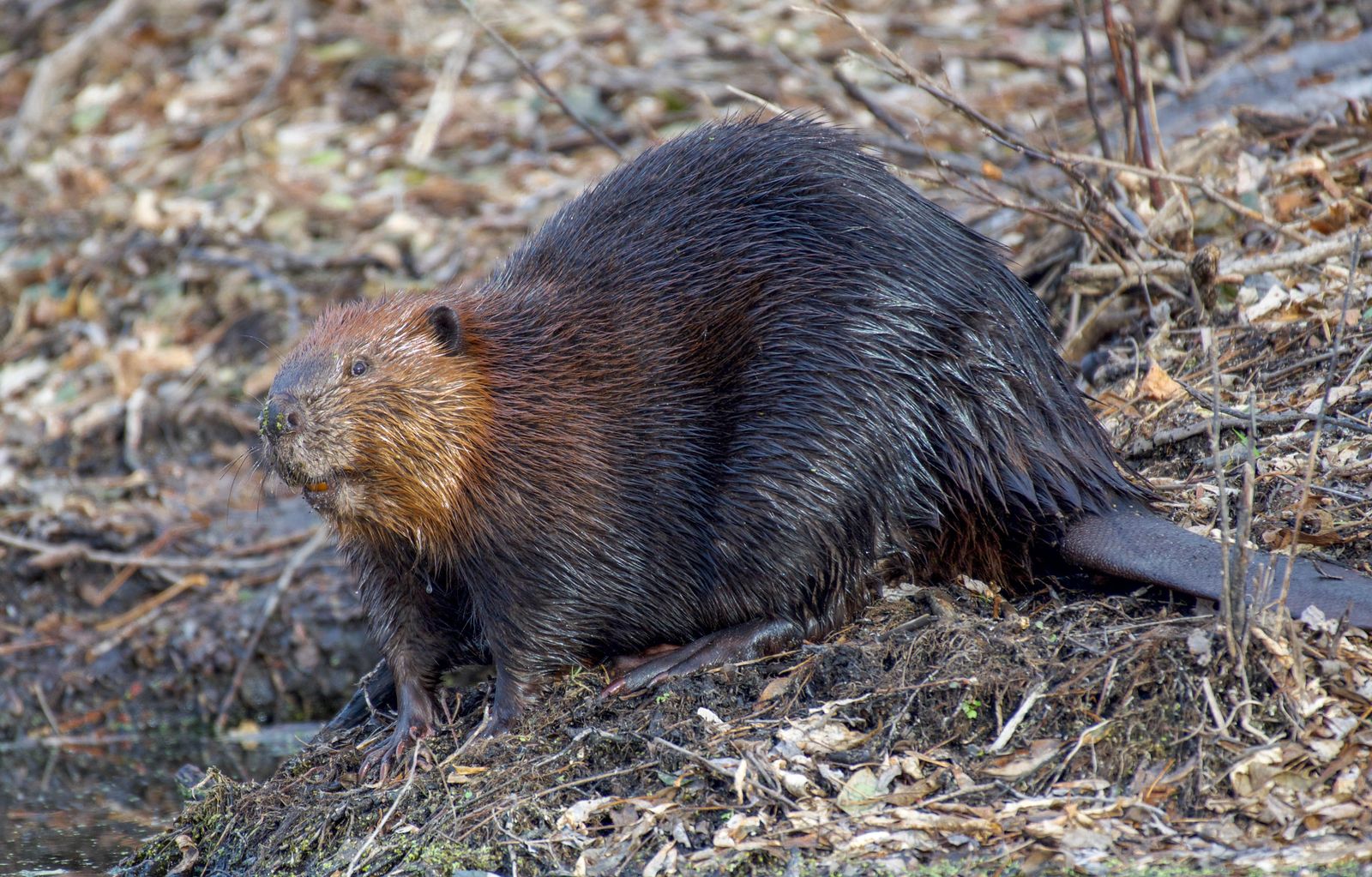
The animal in question is Castor canadensis, the North American beaver, and the numbers behind the title are startlingly small for the effect they produce. A single adult weighs between 16 and 32 kilograms — less than a Labrador — and yet a family of four to eight, working a 300-metre stretch of stream, can lift the local water table by more than a metre, cool downstream flows by several degrees during heat waves, and pack the resulting wet meadow with soil carbon at densities that outstrip the coniferous forest the pond partly drowns.
The mechanism is the dam. Beavers cut willow, aspen, and cottonwood, drag the stems into the channel, weave them with mud and stones, and hold water on the landscape that would otherwise race to the sea. The dam is the smallest piece of civil engineering in the watershed and, hectare for hectare, one of the most consequential. Recent hydrological work in the western United States has begun to put firm numbers on effects that ranchers and trappers described anecdotally for two centuries.
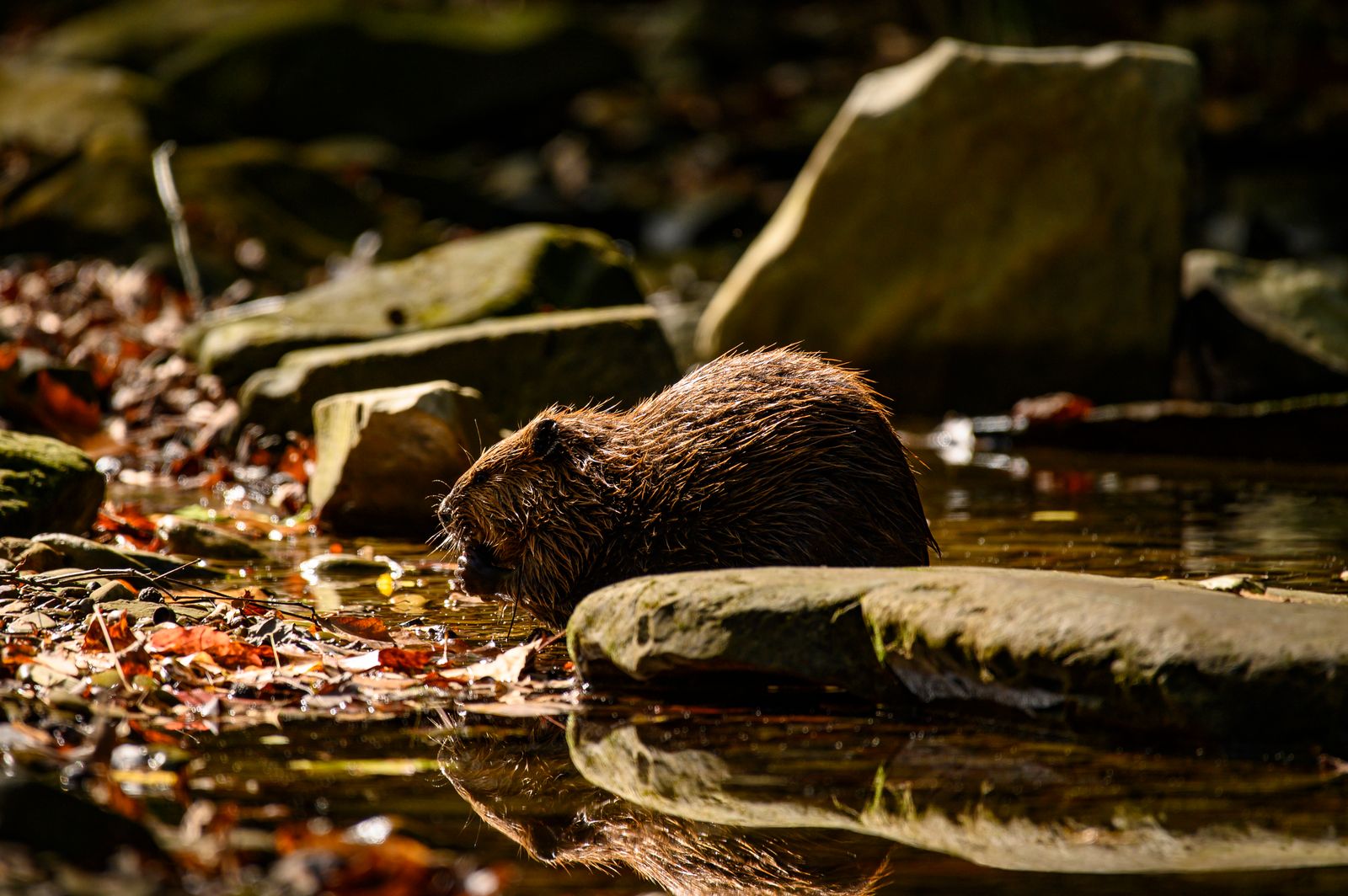
The water table lifts because the pond leaks sideways
A beaver pond is not a bathtub. It is a shallow, muddy, deliberately porous impoundment that pushes water outward through the streambanks and downward into the alluvial aquifer beneath the valley floor. Analysis of satellite surface-water data published in Nature showed how sensitively small impoundments modify local hydrology, and ground studies have since filled in the detail: where beavers colonise an incised stream, saturated soils spread laterally for tens of metres on either bank, and the water table in the surrounding meadow rises accordingly.
The pond becomes a slow-release reservoir. Rain and snowmelt that would have flashed downstream in April are still seeping out of the banks in August. In the Kawuneeche Valley on the western side of Rocky Mountain National Park, researchers tracking the collapse of a historic beaver complex have documented the reverse effect — as dams failed, the water table dropped, willows died, and the meadow began to dry into sagebrush.
The valley is running the experiment in both directions at once.
Why downstream water comes out cooler
The temperature effect is where the title claim needs care. A beaver pond, exposed to summer sun, can be warmer at the surface than the stream that feeds it. What happens downstream depends on what fraction of the outflow comes from that warm surface layer and what fraction comes from the cold groundwater the pond has been recharging all spring.
Field observations in dam complexes across the American West and British Columbia suggest that in many settings the groundwater pathway dominates in late summer. Water that infiltrated the banks in May emerges from seeps and springs downstream in August at something close to the mean annual air temperature — cold, in a mountain valley, compared with a shrunken un-dammed creek running over sun-baked cobbles. Conservationists in northeast British Columbia have been reintroducing beavers to drought-stricken watersheds partly on the strength of this cooling signal, which matters enormously to salmon.
The picture is not universal. A review in The Conversation cautions that beaver benefits vary by setting, and that some ponds warm shallow reaches even as they cool deeper ones. The right framing is that beavers add thermal complexity — deep cold refuges, shallow warm shelves, groundwater seeps — where a straight incised channel offered one uniform, and increasingly hot, temperature.
The carbon math of a drowned forest
The third piece of the title is the strangest. When a beaver dam raises the water table, it kills standing trees along the flooded margin. That looks, at first glance, like a carbon loss: living biomass converted to snags. The accounting flips when you look at the soil.
A dry coniferous forest floor decomposes almost everything it produces. Leaves fall, needles fall, roots die, and fungi and bacteria oxidise the carbon back to CO₂ within a few years. A beaver meadow does the opposite. Waterlogged soils are anoxic; decomposition stalls; organic matter piles up as centimetres, then metres, of black peaty muck. Sediment washed in from upstream settles behind the dam and gets buried under the next season’s leaf litter. Over decades, a beaver complex can accumulate soil carbon stocks that exceed the biomass carbon of the forest it displaced.
The parallel to peat is exact, and it is worth stating plainly. Moon Daily has covered why draining a single hectare of tropical peatland releases more carbon than clearing the rainforest above it — the same physics governs a beaver meadow. Keep the ground wet and the carbon stays put. Let it dry and centuries of storage vent to the atmosphere in a decade.
Four hundred million engineers, then almost none
Before European contact, as many as 400 million beavers occupied North American watersheds. The fur trade of the 18th and 19th centuries reduced them to something close to functional extinction across most of their range. What vanished with them was not just an animal but a landform: the stepped, ponded, willow-choked wet valley that had been the default state of streams from the Yukon to northern Mexico.
The channels that replaced those wet valleys are the incised, gravel-bottomed creeks that hydrologists now call “degraded” — fast, warm in summer, dry by August, and disconnected from the floodplain they used to soak. Restoring beavers is, in effect, restoring the pre-1800 hydrograph.
Even the smallest of Mississippi’s watersheds shows the animal’s continued reach. A recent local dispatch described the return of beavers as the state’s largest rodent, rebuilding ponds in bottomland hardwood systems that had not seen a dam in living memory.
Relocation as climate policy
The programmes that move beavers from where they are unwelcome to where they are needed have quietly become one of the cheaper forms of climate adaptation. The Tulalip Tribes’ Beaver Project in Washington’s Snohomish Watershed traps “nuisance” beavers from suburban stormwater ponds and releases them into headwater tributaries that need dams. The Methow Beaver Project does similar work in the eastern Cascades. These programmes relocate beavers to rebuild wetlands at a cost per hectare that no engineered project can match.
Where live beavers are scarce or slow to arrive, restoration crews build what are called beaver dam analogs — lines of wooden posts driven into the streambed and woven with willow. The analogs slow the water, catch sediment, and raise the water table enough to grow the willow that a beaver, once it shows up, will use to build the real thing. Think of them as scaffolding for an ecosystem engineer that has not yet moved in.
The salmon, the fire, the drought
The knock-on effects are where the arithmetic gets generous. Beaver ponds create deep, cold pools with woody cover — precisely the habitat that juvenile coho and Chinook salmon need to survive their first summer. The dams trap fine sediment that would otherwise smother egg nests in the gravel downstream, and periodic dam breaches scour new gravel patches for spawning.
The ponds also act as fire breaks. During the megafires of the 2020s in Oregon, Idaho, and northern California, satellite imagery repeatedly showed green ribbons of beaver-wetted valley cutting through black burn scars. The wet meadow does not burn. The willow regrows within a season. The pond becomes refuge habitat for everything from moose to tree frogs while the surrounding forest recovers.
Federal agencies spend substantial resources on wildfire fuel treatment — thinning, brush disposal, firebreak construction. A beaver family does a version of the same work, for free, and produces a wetland as a byproduct.
The friction
None of this makes beavers easy neighbours. They flood culverts. They chew ornamental trees. They dam irrigation ditches that farmers spent decades digging straight. In 2020 the United States Department of Agriculture’s Wildlife Services killed more than 25,000 of them, mostly to resolve conflicts with roads and private property.
The tools to coexist exist and are cheap. Flow devices — pipes and fences colloquially called “beaver deceivers” — let water through a dam at a set level while leaving the structure itself intact. Wrapping the trunks of valued trees with wire mesh protects them from the incisors. Culvert protection fences keep dams out of road crossings. None of these are expensive relative to lethal trapping, which tends to be repeated year after year because new beavers colonise the empty habitat within a season.
A thirty-kilogram lever
The reason a rodent under 30 kilograms can shift a valley’s hydrology, temperature, and carbon budget is that the beaver is not doing the work directly. Water is. Sediment is. Anoxia is. The animal simply places a stick in the right spot, and gravity, capillarity, and microbial chemistry do the rest, on a timescale of decades, across every stream small enough for a family group to defend.
What the animal offers is placement. Where a hydrologist would need permits, a contractor, and a budget cycle to build a leaky weir, a beaver builds one in a weekend, maintains it nightly, replaces it after every flood, and passes the job to its kits. The dam is not a monument. It is a habit.
In the Kawuneeche, ecologists are now trying to hand the habit back. Willows are being replanted along dried channels. Post-and-willow analogs are being staked into the streambed to hold water long enough for the vegetation to root. The bet is that once the willow returns, the beaver will follow, and the meadow that has been drying since the 1940s will begin the slow work of getting wet again.
Somewhere upstream, a five-year-old kit is dragging a green stem twice its length across the current, wedging it into a gap only it can see, and lifting — by a millimetre this week, a metre this decade — the water table of a valley it will never leave.