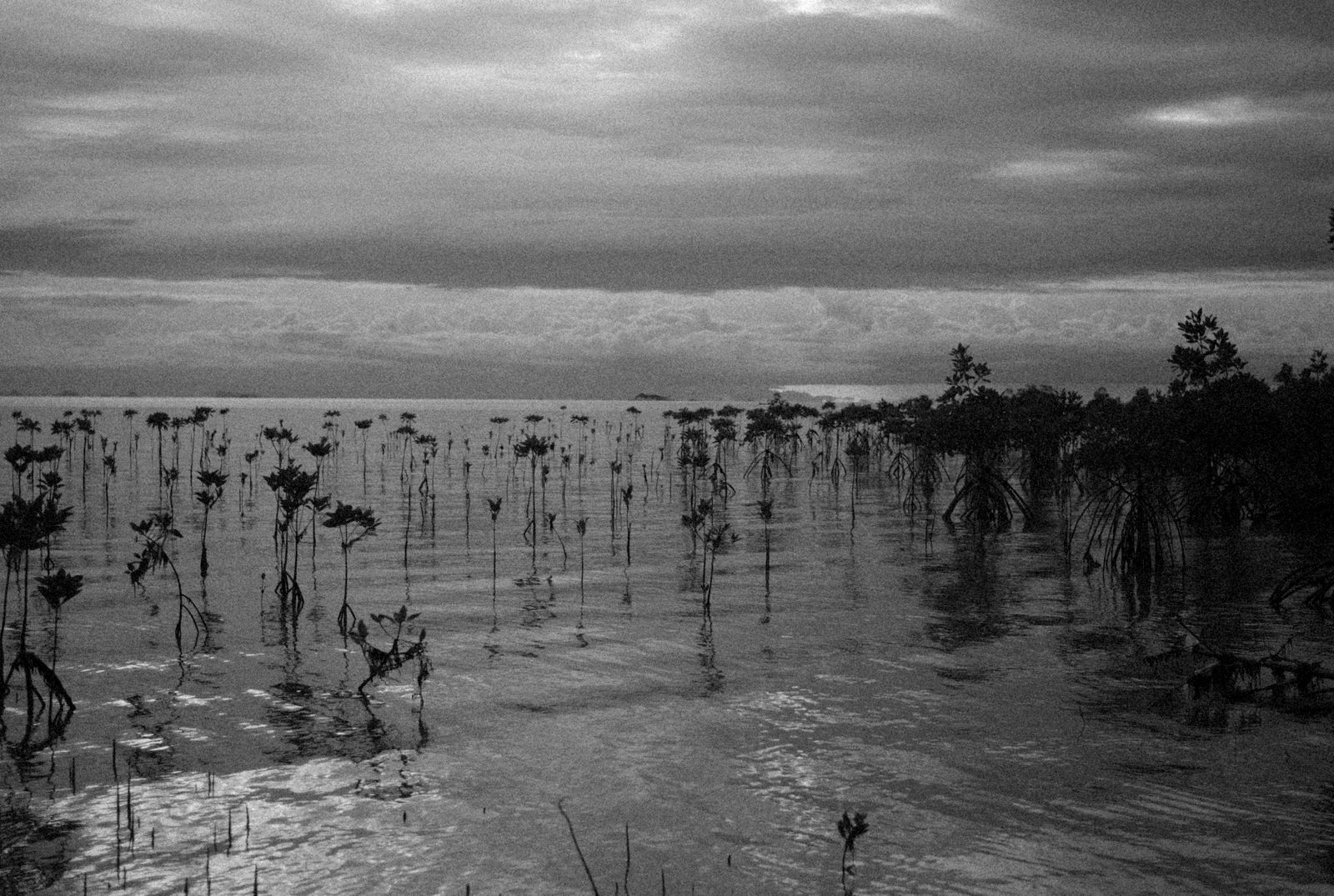
A single hectare of intact mangrove forest can lock away roughly 1,000 tonnes of carbon — three to five times what an equivalent hectare of mature tropical rainforest holds — because most of that carbon is not in the trunks and branches at all. It is buried in the anoxic, salt-logged mud beneath the roots, where oxygen is so scarce that dead leaves, twigs and crab shells can sit for centuries without rotting. Mangroves cover less than one percent of Earth’s surface and yet, according to a 2026 University of Exeter modelling study published in Earth’s Future, they contain about 15 percent of all the carbon stored in ocean ecosystems.
The reason so many replanting schemes fail is almost the mirror image of the reason mangroves work. The carbon-rich mud that makes these forests such potent sinks is also finicky, tidal, chemically specific terrain — and most large plantings put the wrong species in the wrong sediment at the wrong elevation, on mudflats that were never mangrove in the first place. Survival rates in some flagship projects have dropped below 20 percent within ten years.
Where the carbon actually sits
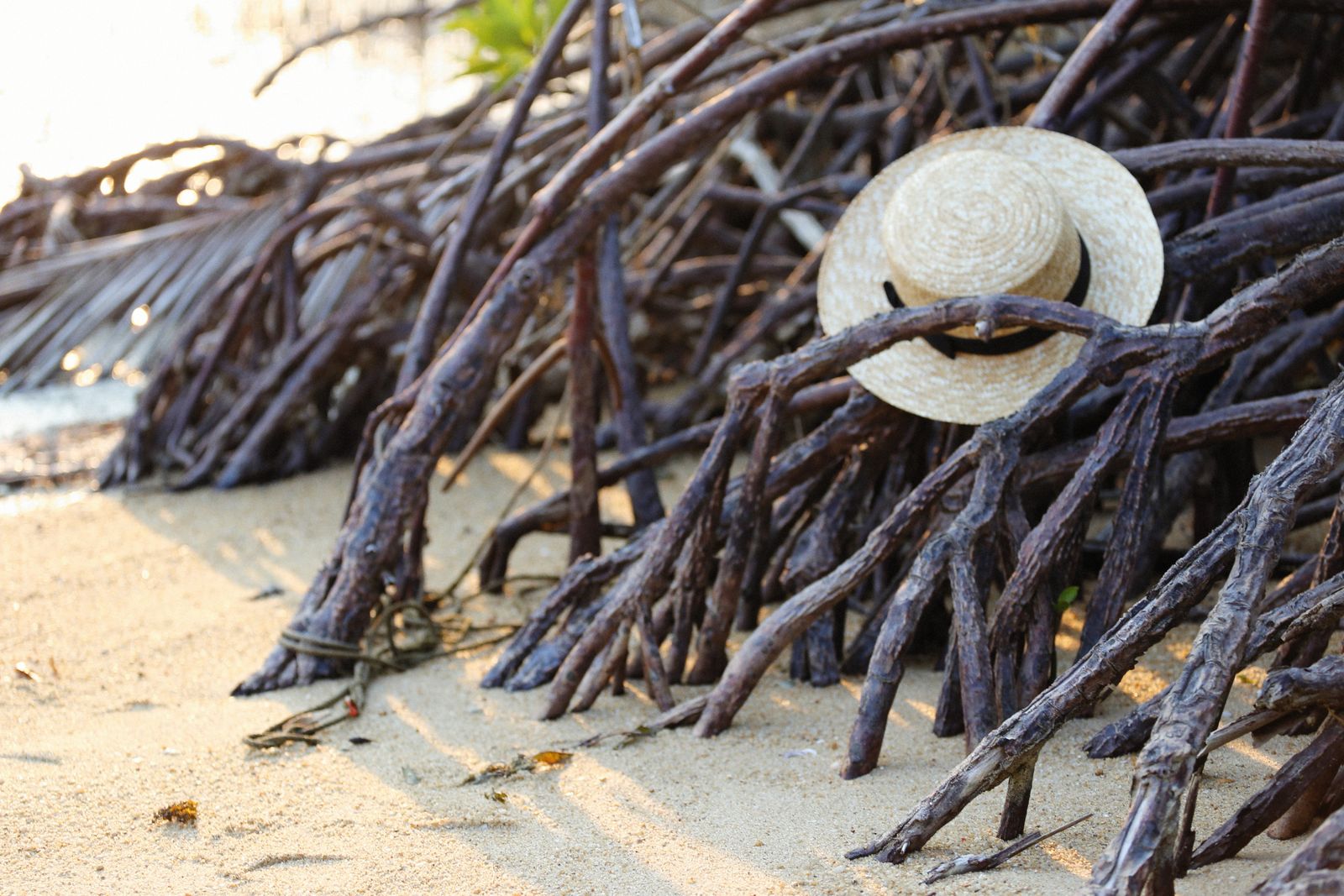
Walk into a mangrove forest at low tide and the smell tells you where the carbon is. It is sulphurous, eggy, slightly sweet — the signature of sediments where microbes have run out of oxygen and switched to sulphate and iron as electron acceptors. In that chemistry, organic matter piles up faster than it can break down.
A rainforest, by contrast, cycles most of its carbon through fast-decomposing leaf litter on aerated soil. The above-ground biomass is spectacular, but the ground beneath it is a busy compost heap. In a mangrove, the ground is a vault.
Field surveys across Indo-Pacific and Neotropical mangroves have repeatedly measured total ecosystem carbon stocks between 800 and 1,200 tonnes per hectare, with 70 to 90 percent of that below the mud line. In the Brazilian Amazon, an inventory of more than 190 forest plots put total ecosystem carbon at about 468 tonnes per hectare, well above the region’s terra firme rainforest; clearing a single hectare of that mangrove releases roughly three times the emissions of clearing a hectare of Amazon forest.
The black carbon nobody counted
There is a second, quieter carbon story hiding in those muds. A 2026 study of the Zhangjiang Estuary in Fujian, China, found that mangrove soils are also stashing a significant and unusually stable pool of black carbon — the aromatic, ring-structured char left over from wildfires and fossil fuel combustion, washed downstream and then trapped in the tidal sediment lattice.
The team, led by Chun Cao and Junjian Wang, measured black carbon concentrations of roughly 0.95 to 1.67 grams per kilogram of soil, with dissolved black carbon ranging from under 1 to more than 12 milligrams per kilogram. Because of its condensed aromatic structure, this material is unusually resistant to decomposition and can persist for centuries. Their findings, released through EurekAlert, suggest the deepest sediment layers hold the most stable fraction of all — the most chemically stubborn carbon accumulating exactly where erosion is least likely to reach it.
That matters for the accounting. Blue carbon inventories that measure only organic carbon miss a component that may already be locked in on geological timescales.
The nitrogen bonus
Carbon is not the only element these forests filter. Mangrove roots trap sediments full of microbes that convert reactive nitrogen — the runoff from farms and sewage that fuels algal blooms — into inert nitrogen gas, which makes up 78 percent of the atmosphere and stays there for thousands of years.
Benoit Thibodeau and Ziyan Wang at the Chinese University of Hong Kong put a price tag on that service. Reviewing 51 prior studies and their own measurements, they estimated that the world’s mangroves remove about 870,000 metric tonnes of nitrogen from coastal waters every year. Priced against what municipalities in Australia and the United States pay to strip nitrogen from wastewater, the cleanup service is worth roughly $8.7 billion a year. Under optimal conditions of temperature, salinity and nitrogen concentration, that figure could climb to $57 billion.
The economic value of the nitrogen removal, Thibodeau and Wang calculated, was twelve times larger than the value of the carbon these same forests sequester. Both services live or die on the same square metres of mud.
Why plantings collapse
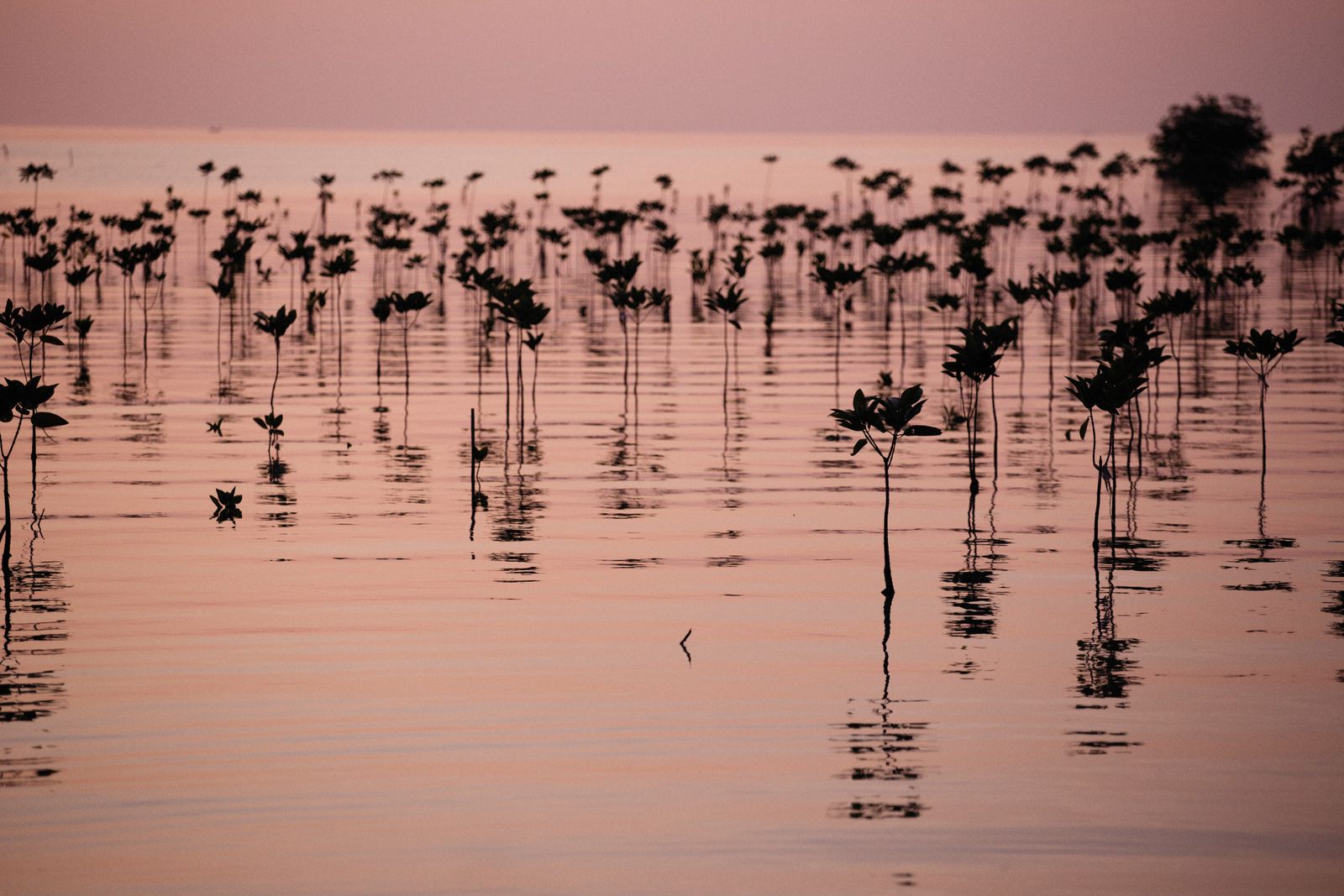
Now the harder half of the question. Since the 1990s, governments and NGOs have planted hundreds of millions of mangrove propagules across South and Southeast Asia, East Africa, and the Caribbean. The failure rate has been brutal.
Across multiple regions, large-scale planting programmes have tracked survival rates that fell below 20 percent within a decade, and in some sites under 10 percent. The pattern is remarkably consistent: seedlings survive the first monsoon, struggle through the second, and are largely gone by the fifth.
Three failure modes explain most of it.
1. Planting on the wrong elevation
Mangroves are hyper-specialised to tidal duration. According to research published in Earth’s Future, mangrove plants are highly specialized and require specific durations of tidal flooding to survive. A few centimetres too low and the seedling is submerged too long, its aerial roots suffocated. A few centimetres too high and salt accumulates in the soil faster than tides can flush it.
Most large plantings target open mudflats or seagrass beds because those areas are easier to access at low tide and appear “empty” to planners. Those flats are typically below the elevation window where mangroves naturally establish. They were never forest.
2. Monocultures of the wrong species
Roughly 70 species of true mangrove exist worldwide, each with different tolerances for salinity, inundation and sediment grain size. Restoration programmes have overwhelmingly favoured Rhizophora — the photogenic stilt-rooted species that looks the part in donor brochures — because its long propagules are easy to collect and push into mud.
Rhizophora is a mid-to-low intertidal species. Planted on higher ground meant for Avicennia or Sonneratia, it dies. Planted on lower ground meant for seagrass, it drowns. A 2026 Mongabay analysis of global restoration data noted that natural regeneration often outperforms planting when the underlying hydrology is intact, because seeds find their own elevation.
3. Ignoring what killed the forest in the first place
Most cleared mangrove land was cleared for a reason — shrimp aquaculture ponds, rice paddies, salt pans, coastal roads. The pond dikes, the altered drainage, the acid-sulphate soils exposed to air: these changes persist after the ponds are abandoned. Planting propagules into a former shrimp pond without breaching the dikes to restore tidal flow is planting into a bathtub.
The most durable restorations of the last two decades — in the Mekong Delta, in Guyana, in parts of Indonesia’s Demak coast — began not by planting trees but by rebuilding hydrology. Permeable brushwood dams, breached dikes, restored tidal creeks. The mangroves came back on their own once the water moved correctly again.
Sea level rise moves the goalposts
Even where restoration works, the target itself is shifting. The University of Exeter modelling team linked water flow, sediment transport, mangrove growth and carbon burial into a single simulation and ran it against several IPCC sea-level rise scenarios. The verdict was mixed at best.
In the near term, some locations gain carbon as rising water deposits more sediment. But as flooding duration exceeds species tolerances, mangroves die back and the carbon-rich soils beneath them erode. Research from the University of Exeter shows that when mangroves die and their carbon-rich soils erode, these ecosystems can shift from carbon sinks to carbon sources. Under higher-emission scenarios, the whole forest system moves from net storage to net release within the century.
The math is harsh. A mature mangrove has been laying down mud at roughly 1 to 5 millimetres a year for centuries. If sea level rises faster than that — and under current trajectories much of the tropical coast will see 5 to 10 millimetres per year by 2050 — the forest cannot keep vertical pace. Landward retreat is the only option, and landward is usually a road, a shrimp farm, or a city.
What the successes look like
The counter-examples are worth naming because they share a template. Bangladesh’s Sundarbans replanting, the Vietnam Red Cross coastal belts in Nam Dinh, the Guyana Mangrove Restoration Project — all began with hydrological restoration, all used mixed-species mother trees rather than nursery monocultures, and all treated the local community not as labour but as long-term managers. Moon Daily has previously covered how Bangladesh combined coastal afforestation with concrete cyclone shelters to cut storm mortality by more than 99 percent since 1970.
NASA’s Earth-observing satellites have been tracking the carbon dynamics of coastal wetlands from orbit, mapping canopy height and biomass across the Everglades and Gulf of Mexico. The agency’s coastal wetland carbon programme now feeds directly into state-level restoration accounting, giving planners something they historically lacked: a way to check, from space, whether a project is actually building biomass or just planting sticks.
The economic case gets harder to ignore
Add the numbers together. Roughly 1,000 tonnes of carbon per hectare. Nitrogen removal worth $8.7 billion a year globally. Storm surge attenuation that, in the Sundarbans, cuts wave energy by up to 66 percent over 100 metres of forest. Nursery habitat for fisheries that support tens of millions of coastal households.
Global mangrove cover has fallen from roughly 200,000 square kilometres in 1980 to about 136,000 square kilometres today, a loss of nearly a third within a single human lifetime. Most of that loss went to shrimp ponds that were themselves abandoned within a decade, leaving acid-sulphate wastelands where forest used to buffer typhoons.
The species is not the problem. The mud is not the problem. Mangroves know how to grow — they have been doing it, in the same tidal zones, for at least 75 million years. The problem is that the plantings that photograph best are the ones least likely to survive, and the restorations that survive are the ones that start by ripping out a dike and walking away.
Somewhere in the Sundarbans right now, in a patch of mud that has been quietly accumulating leaf litter since before the Mughal Empire, a fiddler crab is dragging a mangrove propagule down its burrow. The carbon in that leaf will still be there when the tide comes in a thousand times, and a thousand times after that, provided the sea does not rise faster than the mud can climb.