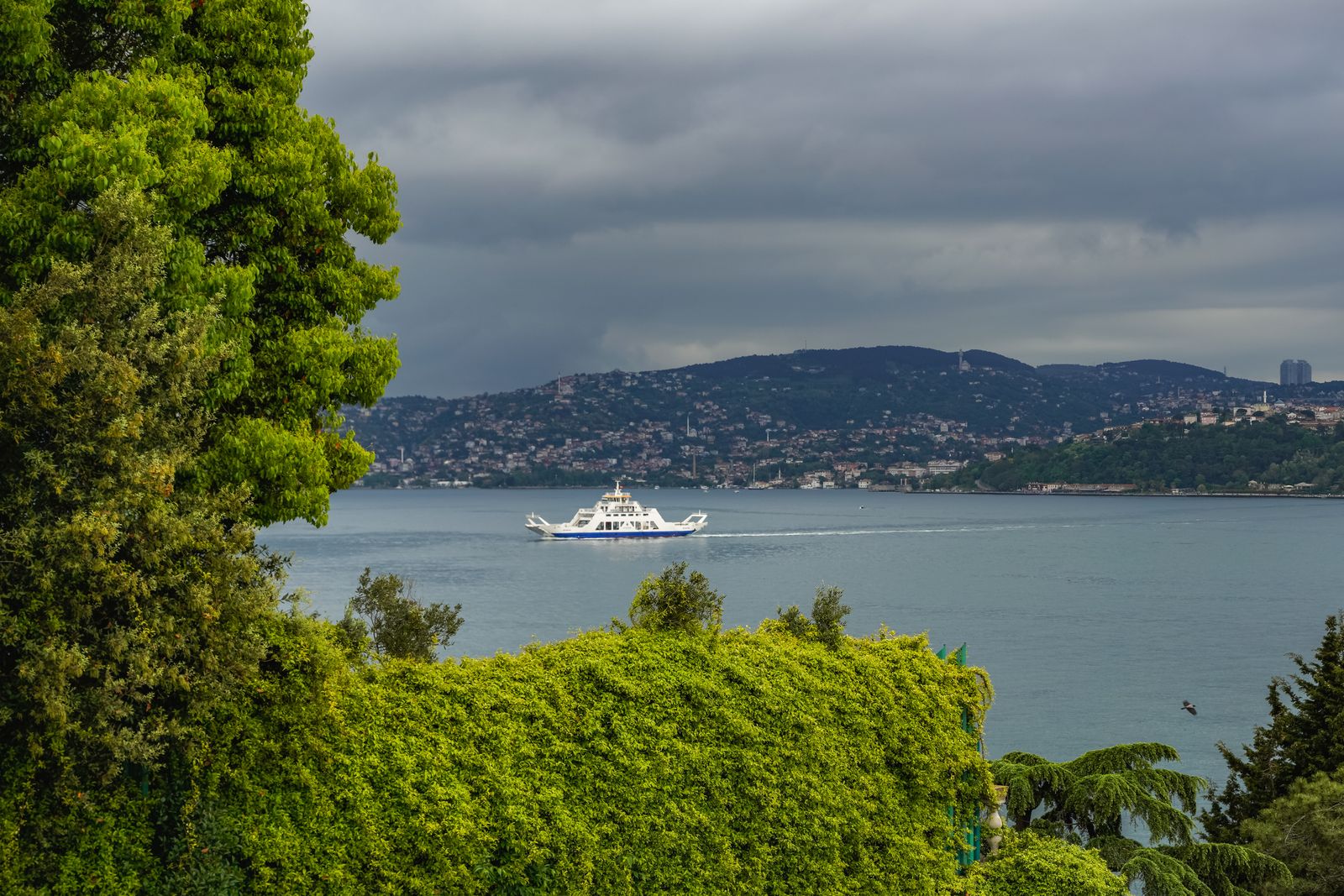
At the far southern edge of South America, the drive between mainland Chile and Tierra del Fuego pauses at a stretch of grey water where the wind decides who moves. The ferry between Punta Delgada and Bahía Azul takes about half an hour when it runs. When a Patagonian gust rises over the strait, trucks queue on the ramp and families wait in idling cars, sometimes for hours. Chile’s Magallanes region wants that wait gone by 2035, and the plan on the table is a road tunnel bored under the seabed at Primera Angostura, the narrowest pinch of the Strait of Magellan.
The proposal has gained official standing in regional planning. The tunnel project has been included in the Magallanes development plan for 2025 to 2035, where it appears as Initiative 49. Regional governor Jorge Flies has said a concession-based preliminary proposal could reach Chile’s Ministry of Public Works in the second half of 2026.
A crossing measured in wind, not distance
The width of the crossing itself is small. The Primera Angostura link runs about 3.7 kilometres, or 2.3 miles, of open water separating Punta Delgada on the mainland from Bahía Azul on the island. A finished tunnel would be longer, because engineers need shore approaches and a gradual descent beneath the seabed before the road can come back up on the other side.
Roughly 2,150 people and 600 vehicles make the crossing each day, a figure attributed to Chile’s Diario Financiero. That is modest traffic by urban standards. It is also, in this part of the world, a lifeline.
The ferry is not a scenic ride. It is a freight artery, a school-run substitute, and the only road link between mainland South America and the sheep stations, oil fields, and towns of Tierra del Fuego. One bad weather window ripples through delivery schedules for days.
What the planning document actually says
The Magallanes regional development plan treats the missing road link as an official regional problem. It lists the tunnel at Primera Angostura as a target for 2035. That gives the idea planning standing. It does not commit a budget, choose a construction method, or promise an opening date.
The distinction matters. Line items in regional plans are the earliest phase of a public works project. They authorise studies, not shovels.
For now, private specialists are gathering information for a preliminary proposal to the Ministry of Public Works. That is the next real milestone. Not a ribbon-cutting, not a tunnel-boring machine being lowered into a shaft, but a document credible enough for the ministry to accept and fund the next round of geotechnical work.
The Norwegian number, and why it moved
Early estimates put the project near $1.5 billion. Flies now says Norwegian tunnel specialists put the figure closer to $500 million, about a third of the original, with a private concession as a possible financing route.
Norway has a reason to have an opinion. The country has built subsea road tunnels beneath its fjords for decades, so its consultants tend to arrive with hard data on drill-and-blast costs in wet, fractured rock.
Independent estimates land elsewhere. Civil engineer Francisco Hernández of the Universidad de los Andes has priced the work at roughly $400 million per kilometre, or about $1.48 billion for the full project. A spread of three to one is normal at this stage of a megaproject, and it is exactly why regional planners are asking for money to study the seabed rather than money to dig it.
Shallow water, and glacial mud below
The strait is not deep at Primera Angostura. University of Magallanes engineer Jorge Villarroel Ortega puts the water at 92 to 131 feet, in a basin with complex, glacially shaped geology. He considers the tunnel technically possible, but has called for large-scale geotechnical and geophysical work before anyone commits to a method.
The variable that decides everything is permeability. If the rock and sediment let too much seawater through, construction slows, pumps multiply, and the price climbs.
The choice of method — conventional drill-and-blast, a tunnel-boring machine, or an immersed tube dropped into a dredged trench — depends on what those drilling samples show. A boring machine works well in consistent ground. Glacial deposits are famously inconsistent, a mix of clay, gravel, and boulders left behind when the ice retreated roughly 10,000 years ago.

Why the traffic argument crosses a border
The tunnel would sit entirely in Chilean territory. Most of its future users might not be Chilean.
Road travel between mainland Argentina and the Argentine half of Tierra del Fuego already routes through Chile and across the strait, because the geography leaves no other option. The largest cities on the island — Río Grande and Ushuaia — are both Argentine. Hernández has argued it is vital to seek a partnership with Argentina, because Chilean traffic alone may not justify the price.
Flies has gone further, suggesting the fixed link could eventually become Chile’s third-busiest border corridor. That is a promoter’s forecast. Serious demand modelling and a bilateral agreement on tolls, customs, and maintenance would need to come first.
The company Chile would be joining
Buried strait crossings are having a moment. China has been advancing plans for a Bohai Strait tunnel, a 75-mile link where high-speed trains are planned to cover the strait in about 40 minutes, replacing a ferry journey of six to eight hours. About 56 miles of that route would run underwater, which would make it the world’s longest subsea tunnel.
The caveat is the one Chile should read closely. Despite headlines about a subsea bullet train, the Bohai project remains a planning effort rather than an operating tunnel, an idea first raised in 1992 and still short of construction more than thirty years on.
Europe has moved slowly too. The proposed Spain–Morocco rail tunnel across the Strait of Gibraltar will not be finished in time for the 2030 World Cup, with a realistic window now put at 2035 to 2040 after decades of study. Singapore, meanwhile, has just begun studying undersea tunnels to link Pulau Tekong to the mainland, a project its prime minister has openly described as taking decades.
Chile’s proposed 2035 target sits inside that global pattern. It is aggressive if construction begins in the late 2020s, and comfortable if it slips into the early 2030s.
What the studies actually look like
Hernández has estimated about two years of engineering and ground studies, followed by roughly six years of construction. The clock has not started.
Ground studies at this scale mean deep drill cores taken from a barge in the strait, seismic reflection surveys that map layers below the seabed, sediment sampling for grain size and permeability, and long-term monitoring of currents and salinity. All of it happens in one of the windiest working environments on Earth.
The Southern Ocean westerlies run almost unbroken around this latitude and funnel through the strait. Strong gusts are routine even in summer. That is the same weather that stops the ferry — and the same weather that makes offshore drilling campaigns expensive.
What a driver would feel
If the tunnel opens, the crossing becomes invisible. No boarding ramp, no lifejackets in an overhead rack, no wondering whether the 2 p.m. sailing has already been cancelled by the wind. A truck driver leaves Punta Arenas in the morning and reaches Porvenir or Río Grande without ever slowing for water.
The trip inside would be short — a few minutes at highway speed through a lit concrete bore, air pushed by jet fans, emergency exits marked at regular intervals, drainage pumps humming behind the wall panels. The quieter the drive feels, the more machinery is running out of sight.
An undersea road tunnel needs ventilation strong enough to clear a truck fire, emergency refuges every few hundred metres, redundant power, and a control room watching every camera and sensor. Norway’s operators learned this the hard way. Investigations into fires in the Gudvanga and Oslofjord tunnels found under-dimensioned equipment, ventilation that blew smoke the wrong way, and evacuation aids that failed the people relying on them.
The economic question that will not go away
A tunnel can be buildable and still fail the concession test. In sparsely populated regions, tolls have to be high enough to repay the debt but low enough that drivers still use the road. Get the balance wrong and traffic collapses back to the ferry, which would almost certainly keep running for pedestrians and light vehicles anyway.
Regional supporters point to tourism, cross-border commerce, and proposed green hydrogen investments near the eastern Strait of Magellan as future demand. Those benefits are plausible. They also depend entirely on how many users the tunnel attracts, what drivers would pay, and whether the time saved justifies a project of this size.
What 2035 really means
The date on the planning document is a target, not a deadline. It signals that the Magallanes regional government intends to have a tunnel operating within a decade. Whether that happens depends on the Ministry of Public Works accepting the preliminary proposal, funding the geotechnical campaign, agreeing terms with Argentina, awarding a concession, and letting a contractor spend six years building under the seabed.
Each of those steps is a place where the project can slip by a year or five. Megaprojects usually do.
For now, the ferry keeps sailing when the wind allows. Cars line up at Punta Delgada with their engines off. Somewhere, a preliminary proposal is being drafted. And beneath the surface of Primera Angostura, in glacial mud that has not been disturbed since the last ice age retreated, the rock is waiting to find out whether anyone is going to drill it.