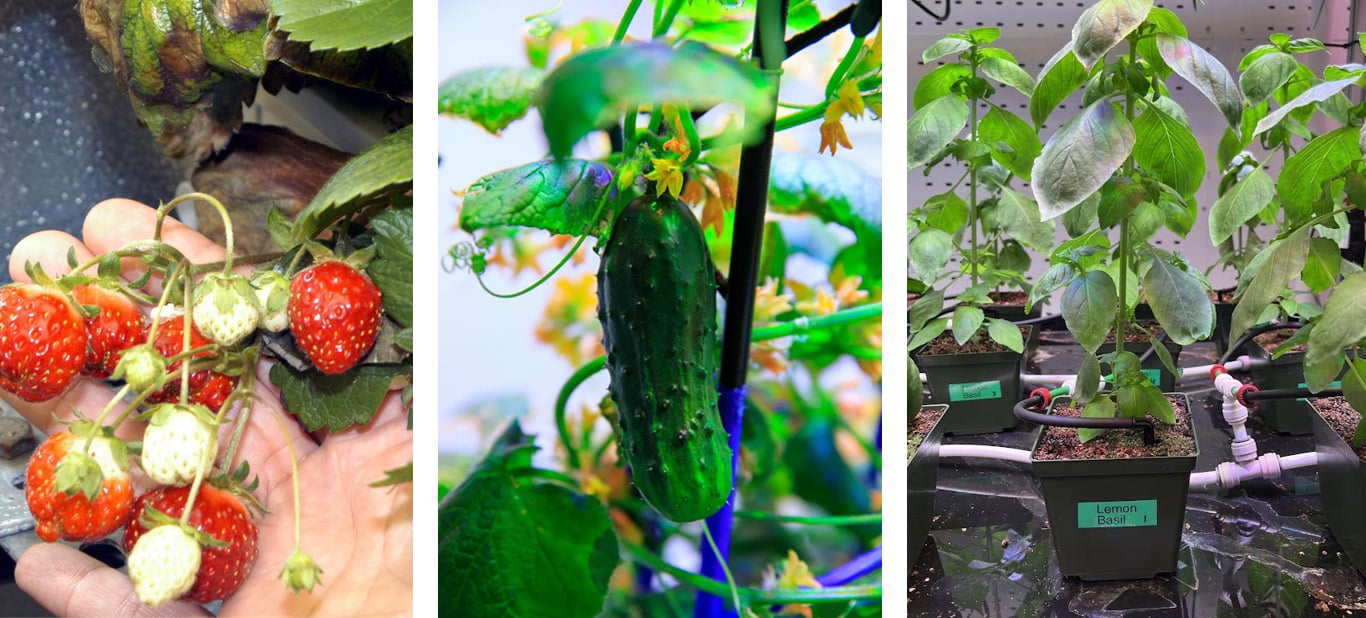
A wild strawberry with small yellow fruit beat NASA’s leading strawberry candidate on flowering and fruit counts in a recent test, but it did not take its place. Grown from seed, the wild plant made twice as many buds, flowers and fruit as Delizz, the cultivar NASA currently favours. It also sent out so many runners that Delizz kept the top spot.
The comparison is one of several crop tests NASA described in an update published on 25 November 2026. The NASA Science Editorial Team wrote: “Recent testing points to strawberries, cucumbers, and lemon basil as potential options for future explorers.”
NASA presents all three as candidates, not settled choices.
The strawberry study was a collaboration between NASA’s Kennedy Space Center, the University of Melbourne and the University of Western Australia. The results appeared in September in Life Sciences in Space Research, in a paper that set out to identify a new candidate space crop.
The two plants look different. Delizz produces large red fruit. The wild strawberry, an alpine strawberry known as Fragaria vesca, bears small yellow fruit. NASA attributes the colour to a recessive mutation.
The researchers compared F. vesca accession Hawaii 4 (F7) with the cultivated strawberry Fragaria x ananassa ‘Delizz’. Plants grew in deep-water culture hydroponics under conditions meant to simulate an enclosed habitat. Harvests on days 0, 43 and 78 gave repeated measurements across the trial.
Seed-grown F. vesca had 1.4 times the specific leaf area of seed-grown Delizz, and twice the buds, flowers and fruit.
The difference did not show up in every measure. At day 78, the authors found no significant difference between the two plants in total biomass or in harvest index.
Seed is a practical starting point for spaceflight. Seeds are small and easy to store and ship.
Runners were the sticking point. Also called stolons, they are horizontal stems a strawberry plant sends out to form new plants. NASA says the wild plant produced too many, and that the extra runners would take up “valuable room aboard a spacecraft.”
In NASA’s summary, Delizz “kept its top spot” because of the wild plant’s runners.
The paper’s own verdict is measured. The authors write that the wild strawberry “appears unsuitable as a space crop in its current form, primarily due to high biomass allocation to runners”. They identify runnerless accessions as a subject for future work. Their conclusion covers the accession they tested in its current form.
Cucumbers and lemon basil in the chamber
Cucumbers were also tested, in a study published in August in HortScience. Some plants developed enlarged leaves. The plants gave a steady stream of edible fruit, according to NASA, which notes that no crop from the gourd family has yet been grown in space. That means cucumbers could be the first gourd-family crop raised in space.
Lemon basil passed preliminary testing and seed sanitization. The next step is growing it in plant pillows.
NASA’s photo caption says the strawberries were grown in the controlled environment chamber of the Space Life Sciences Lab. The cucumbers and lemon basil grew in a controlled environment chamber at Kennedy.
Alongside the crop tests, a new Biological and Physical Sciences (BPS) investigation is set to launch to the International Space Station. NASA describes the investigation’s hardware as a “first-of-its-kind prototype growth chamber” that will inform crop production “for future Moon Base habitats and Mars missions”.
Earlier Moon Daily coverage includes a prototype nutrient mixing system for future Moon and Mars greenhouses and a report on Chinese plans for astronauts to grow vegetables on the Moon.
The study: K. Nakashima, C. Farrell, J. Calabria, A. H. Millar, G. Massa and M. Watt, “Identifying a new candidate space crop: the alpine strawberry Fragaria vesca”, Life Sciences in Space Research, September 2026.