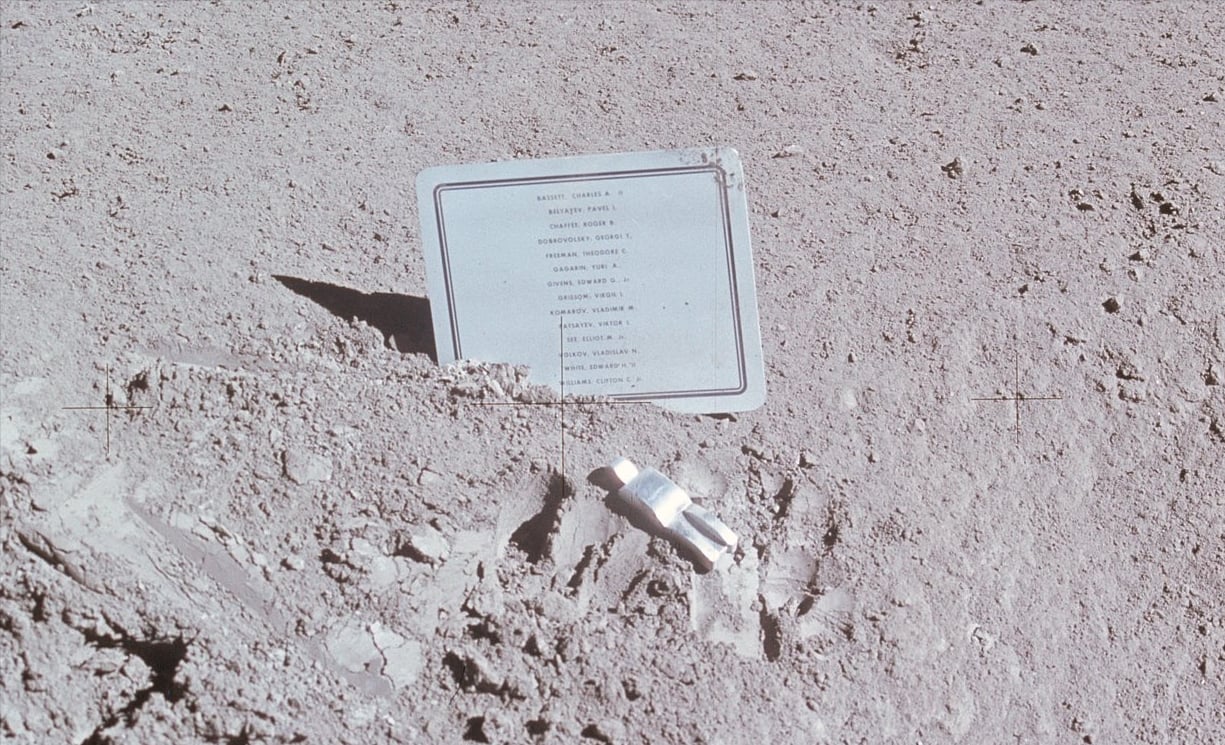
The small figure that Apollo 15 left on the Moon in 1971 was cut from metal. In a memorandum for the record dated 3 September 2021, the mission’s commander, David R. Scott, wrote that it was “precision-machined from a single block of aluminum alloy 6061, the same material approved for fabrication of our lunar surface tools.”
Scott recorded that the design “was based on standard ‘stick-figures’ that had been universally accepted in the late 1960’s as location symbols for bathrooms.”
The figure was one part of a memorial. The other part was a simple plaque carrying the names of 14 astronauts and cosmonauts from both sides of the “Space Race”, in Scott’s phrase. The figure, representing a fallen astronaut, was set near it.
A Soviet crew lost before launch
On 30 June 1971, the three cosmonauts of Soyuz 11 died during re-entry on their return from the Salyut space station. They were Georgi Dobrovolsky, Vladislav Volkov and Viktor Patsayev.
Several days later, on 6 July 1971, Scott attended a NASA management meeting in Houston. Its subject was whether procedures should change after the loss of Soyuz 11. The rest of the Apollo 15 crew were at the Cape.
Scott writes that procedures were not changed.
At the close of the meeting, Deke Slayton, Director of Flight Crew Operations, approved a recommendation from Scott for a memorial on the Moon that would honour both astronauts and cosmonauts.
Scott’s memo calls it “a private and confidential project approved by NASA management”. The memorial was to be put in place at the end of the mission on a time-available basis, after all official duties were done.
From a spacesuit pocket to Hadley-Apennine
In the three weeks before launch, the memo says, the plaque and the figure were “designed and fabricated by NASA personnel”. Both were then stowed in a pocket of Scott’s spacesuit.
Apollo 15 landed at Hadley-Apennine. Scott and the lunar module pilot, James B. Irwin, worked on the surface, while Alfred M. Worden stayed in lunar orbit. NASA Science gives 2 August 1971 as the date of the plaque and says Scott and Irwin stuck it in the lunar soil during their surface EVA.
According to his memo, Scott described the memorial at the Apollo 15 post-flight press conference on 9 August 1971. The memo quotes what he said:
“we left a small memorial on the Moon. About 20 feet north of Rover 1, in a small subtle crater, is a simple plaque with 14 names, and those are the names, in alphabetical order of all the astronauts and cosmonauts who have died in the pursuit of exploration of space. Near it is a small figure representing a fallen astronaut.”
Scott used the term “fallen astronaut” for the figurine at that press conference. NASA released the stereo photographs he had taken of the memorial near Lunar Roving Vehicle No. 1.
NASA Science lists the 14 names on the plaque in alphabetical order: Charles A. Bassett II, Pavel I. Belyayev, Roger B. Chaffee, Georgi Dobrovolsky, Theodore C. Freeman, Yuri A. Gagarin, Edward G. Givens Jr., Virgil I. Grissom, Vladimir Komarov, Viktor Patsayev, Elliot M. See Jr., Vladislav Volkov, Edward H. White II and Clifton C. Williams Jr.
The three Soyuz 11 cosmonauts who had died weeks before the flight are among them.
Two accounts of who made the figure
A published account of the figure’s origin differs from Scott’s. Corey S. Powell and Laurie Gwen Shapiro wrote about it for Slate in “The Sculpture on the Moon”, published on 16 December 2013.
Slate describes a 3 1/2-inch-tall aluminium sculpture that Scott placed near his parked lunar rover on 2 August 1971. The article calls the piece Fallen Astronaut, the same phrase Scott used at the press conference, and attributes it to the Belgian artist Paul van Hoeydonck.
In Slate’s telling, Scott saw the figure as a tribute to astronauts and cosmonauts who had died, and he told the authors that the artist had agreed to remain unknown. Slate reports that van Hoeydonck had a starkly different impression of the project and later wanted credit for it.
Slate also quotes Bruce Gitlin, then head of the Brooklyn foundry Milgo/Bufkin. Gitlin said the prototype and the final piece on the Moon “were carved from aluminum, hand-fabricated by me, because I knew if it was traveling to the moon it had to be light.” He describes working from van Hoeydonck’s model.
Scott’s 2021 memo gives a different account of the figure’s making. It says the figure and the plaque were designed and fabricated by NASA personnel in the three weeks before launch.
The memo also sets out Scott’s view of the memorial’s status. He describes it as a private, personal tribute and writes that neither the figure nor the plaque was ever to be reproduced or commercialised.
Earlier Moon Daily coverage includes a report on how Apollo 12’s Saturn V most probably triggered the lightning that hit it, Van Hoeydonck, first artist to exhibit on Moon, dies and NASA events commemorate 55th anniversary of Apollo 11 moon landing.