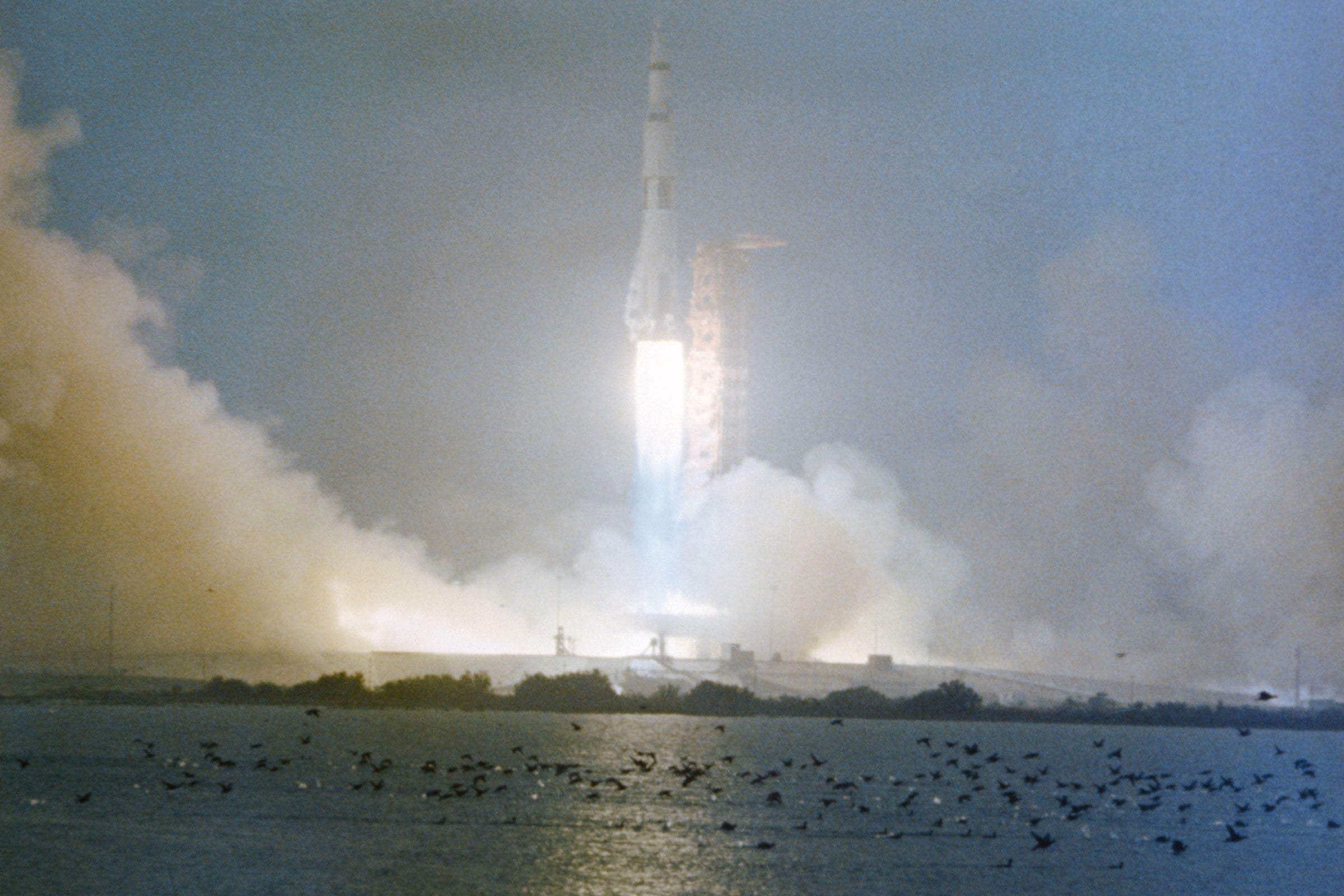
The morning of 14 November 1969 was wet in Florida. A cold front was moving through, and the days before had brought thunderstorms and rain showers. By launch time no rain was falling at Kennedy Space Center, but the sky was overcast, with cloud between 2,000 and 10,000 feet. The weather was within the launch rules, as the Apollo Flight Journal’s account of the ascent records.
Apollo 12 carried Pete Conrad as commander, Richard Gordon as Command Module Pilot and Alan Bean as Lunar Module Pilot. NASA’s mission page calls it “The Pinpoint Mission.” The Saturn V lifted off from Pad 39A at 11:22 a.m. EST.
Two flashes in the first minute
Lightning hit the vehicle 36.5 seconds after liftoff. It hit again at 52 seconds.
NASA’s February 1970 report MSC-01540, Analysis of Apollo 12 Lightning Incident, described it in one line: “At 36.5 seconds and again at 52 seconds, a major electrical disturbance was caused by lightning.” At about 36.5 seconds, the report found, the fuel cells were automatically disconnected from the spacecraft power buses.
In the cabin, warning lights came on for the fuel cells and the power buses. At 56 seconds Conrad said in the cabin, “I just lost the platform.”
A few seconds later Conrad repeated that the platform was gone. He said he did not know what had happened and that everything had dropped out.
At 1 minute 12 seconds he read off the alarms: “I got three fuel cell lights, an AC bus light, a fuel cell disconnect, AC bus overload 1 and 2, Main Bus A and B out.”
Three letters on the flight loop
In Mission Control, some of the data on EECOM John Aaron’s screens had turned into unusual numbers that did not look like proper values. Aaron recognised the pattern.
He recalled seeing similar figures when a drop in power to the Signal Conditioning Equipment, or SCE, scrambled the readings during a test of the Command Module. The Flight Journal, citing Aaron’s NASA oral history, places that episode in factory testing.
Flight Director Gerry Griffin remembered it differently. In his NASA Johnson Space Center oral history, recorded on 12 March 1999, Griffin said Aaron “had seen a similar thing happen during a pad test on Apollo where he had lost all the telemetry … The Cape went to the aux position and it restored it”.
Both accounts trace Aaron’s recognition to an earlier ground test of Apollo hardware. They describe different test settings.
Aaron made the call on the loop: “Flight, EECOM. Try SCE to AUX.”
Griffin answered, “Say again? SCE to AUX?” In the 1999 interview he said, “I’d never heard of the switch”.
At 1 minute 36 seconds CapCom Gerald Carr passed the instruction up: “Apollo 12, Houston. Try SCE to Auxiliary. Over.” At 1 minute 50 seconds Conrad said on board, “SCE to Aux.” Bean flipped the switch.
In Griffin’s telling, Bean “knew where that switch was … as soon as he did it, it restored our data”. Aaron reported, “We got it back, Flight. Looks good.”
At 2 minutes 19 seconds into the flight, Carr passed up the command to reconnect the fuel cells to the main buses. The crew did so a few moments before the first stage cut off.
Restoring the telemetry “was not an absolute requirement for the continuation of the ascent,” the Flight Journal says. The crew could still read current and voltage on their own gauges, and “the simple loss of telemetry was not grounds for an abort.”
Griffin recalled thinking at the time: “We’re gaining altitude. We’re okay.”
Orbit, the Ocean of Storms and the 1970 report
The guidance platform had tumbled into gimbal lock during the ascent. Once Apollo 12 reached Earth orbit, the crew realigned it. The mission went on to the Moon.
On 19 November 1969, five days after the launch, Conrad and Bean landed in the Ocean of Storms and walked on the surface. Gordon stayed in lunar orbit. The mission ended on 24 November 1969.
The NASA analysis published in February 1970 looked at where the lightning had come from. Its authors pointed to the vehicle itself. “Lightning can be triggered by the presence of the long electrical length created by the space vehicle and its exhaust plume in an electric field which would not otherwise have produced natural lightning,” the report states.
The report’s appendix stressed that Apollo 12 was not launched into a thunderstorm. For six hours before launch, and for a similar period afterwards, no other lightning strokes were observed or recorded and no thunder was heard. Electric field meters gave readings consistent with disturbed weather, but a lightning flash counter at nearby Patrick Air Force Base recorded no strokes except the one tied to the flash at 36.5 seconds. From that, the authors drew their conclusion: “It is most probable, therefore, that the passage of the vehicle through an electrified cloud incapable of producing lightning on its own, triggered the lightning flashes at 36.5 seconds and 52 seconds after launch.”
The report listed the permanent effects as the loss of nine non-essential instrumentation sensors.
Very little was changed on the spacecraft or the rocket afterwards, according to the Flight Journal. The rules in force on 14 November had allowed the launch. They were amended so that no launch attempt would be made in weather where lightning was likely to form.
Earlier Moon Daily coverage of the Apollo programme includes NASA’s events marking the 55th anniversary of the Apollo 11 landing, a new analysis of Apollo samples brought back in 1972 and a look back at what the first lunar programme delivered.