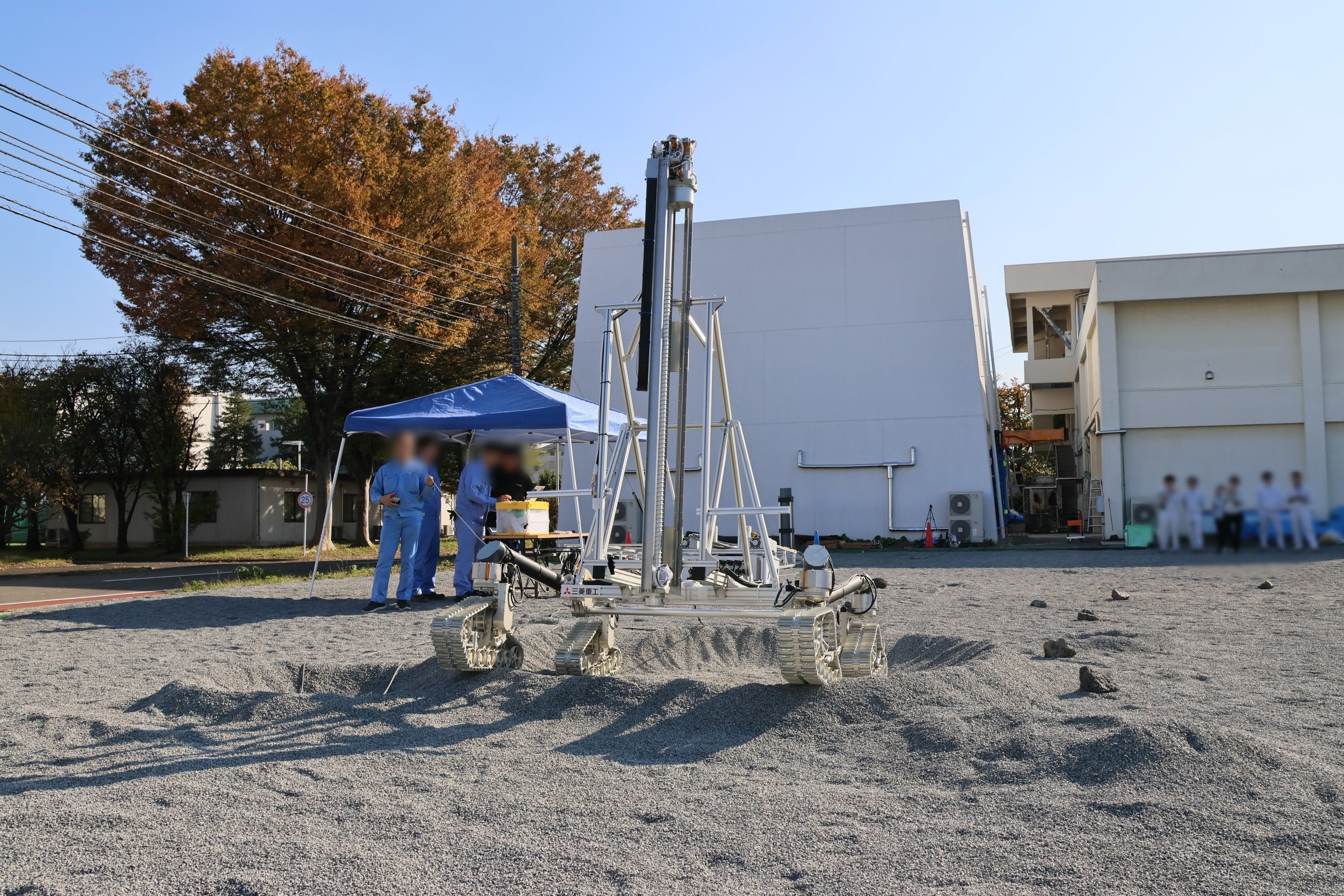
TOKYO (Chofu): The Japan Aerospace Exploration Agency drove a test model of its LUPEX lunar rover over rocks and a crater-like depression at its Chofu Aerospace Center on Wednesday, 25 November 2026. Japan and India plan to send the rover to the Moon’s south polar region.
The run was the subject of a JAXA media notice. Jiji Press, in a report carried by The Japan Times, said the model moved on caterpillar tracks attached to its four legs. The machine shown at Chofu is a ground test model, not the rover that will fly.
News reports have described the drive system with different emphasis. AFP described the rover as four-legged, while the Mainichi Shimbun described crawler tracks. JAXA’s own term, a four-legged crawler, covers both.
The rover’s task is to measure water in the polar ground. JAXA’s current Japanese-language mission page says its drill will collect regolith from the surface down to 1 metre or deeper. Instruments on board will then analyse the samples for water content, volatile gases and mineral composition.
One of those instruments, called REIWA, heats samples to measure the water they contain by weight, Nikkei reported. The Mainichi says the rover carries 11 instruments in all. JAXA’s mission page gives its mass as 420 kg including instruments.
The division of work is set out on JAXA’s English-language project page, which carries some older figures. JAXA builds the rover and provides the launch, and India’s space agency, ISRO, builds the lander. Instruments come from Japan, India, the United States and Europe.
The mission page names the lunar south polar region as the target and lists Takeshi Hoshino as project manager. Launch is planned in fiscal 2028, which runs from April 2028 to March 2029, on an H3 rocket from the Tanegashima Space Center. Jiji Press reported the same rocket and timing, and that ISRO develops the lander.
After landing, the rover is to explore for about 100 days, and up to one year, according to JAXA.
Lunar water as rocket fuel
Hoshino linked the rover to a change in how the Moon will be explored. “Using a rover as a means of transportation is important as we move to the next stage of exploration beyond pinpoint landing missions,” he said, as quoted by Jiji Press.
He also pointed to uses for the rover’s drilling work beyond this mission. “Drilling technology will also be useful for building a base on the moon,” Hoshino said.
“We ultimately want to use lunar water for rocket fuel,” Hoshino told reporters on Wednesday, AFP reported.
Hoshino drew a contrast with the International Space Station, AFP reported. More than 90 percent of the water on the station is recycled, he noted. The water produced when a rocket burns oxygen and hydrogen, however, cannot be recovered for reuse. A key objective, in his account, is producing fuel on the Moon for the return to Earth or for travel on to Mars.
Nikkei put the rover’s speed during Wednesday’s run at about 3 cm a second, over a course of about 18 metres. The newspaper reported that the design can handle slopes of up to 25 degrees.
AFP reported that the test campaign has also included climbing slopes on a single leg, continuous driving on two legs and mobility trials under vacuum conditions. The prototype is due to go to India in 2027, the Mainichi said.
Published cost figures differ, and they may not measure the same thing. The Mainichi puts Japan’s total budget for the mission at 37.6 billion yen. A science ministry document from April 2024 gives a total development cost of 24.8 billion yen, a figure that excludes operations.
Earlier Moon Daily coverage includes a JAXA contract for a robotic arm on a crewed lunar rover, China’s Chang’e 7 plans for the lunar south pole and research into where lunar water came from.